- Gartner identifies leader and manager development as the number one HR priority for 2025 and beyond.
- AI fluency is now a foundational leadership capability — not an optional skill.
- Human-centred qualities like empathy, psychological safety, and coaching will define high-performing organisations.
- Leadership development must become hyper-personalised, moving away from one-size-fits-all programmes.
- Coaching and mentorship are no longer supplementary — they are central to leadership maturity.
- Agile, networked leadership is replacing hierarchical management as the dominant operating model.
- Agentic AI — AI that plans and executes autonomously — is creating a new class of digital collaborator that leaders must learn to orchestrate.
The era of “nice-to-have” leadership training is over. As we move through 2026, organisations face a stark reality: the old playbooks for developing leaders and managers are failing. Burnout, technological disruption, and a massive skills gap are threatening to destabilise even the most successful companies.
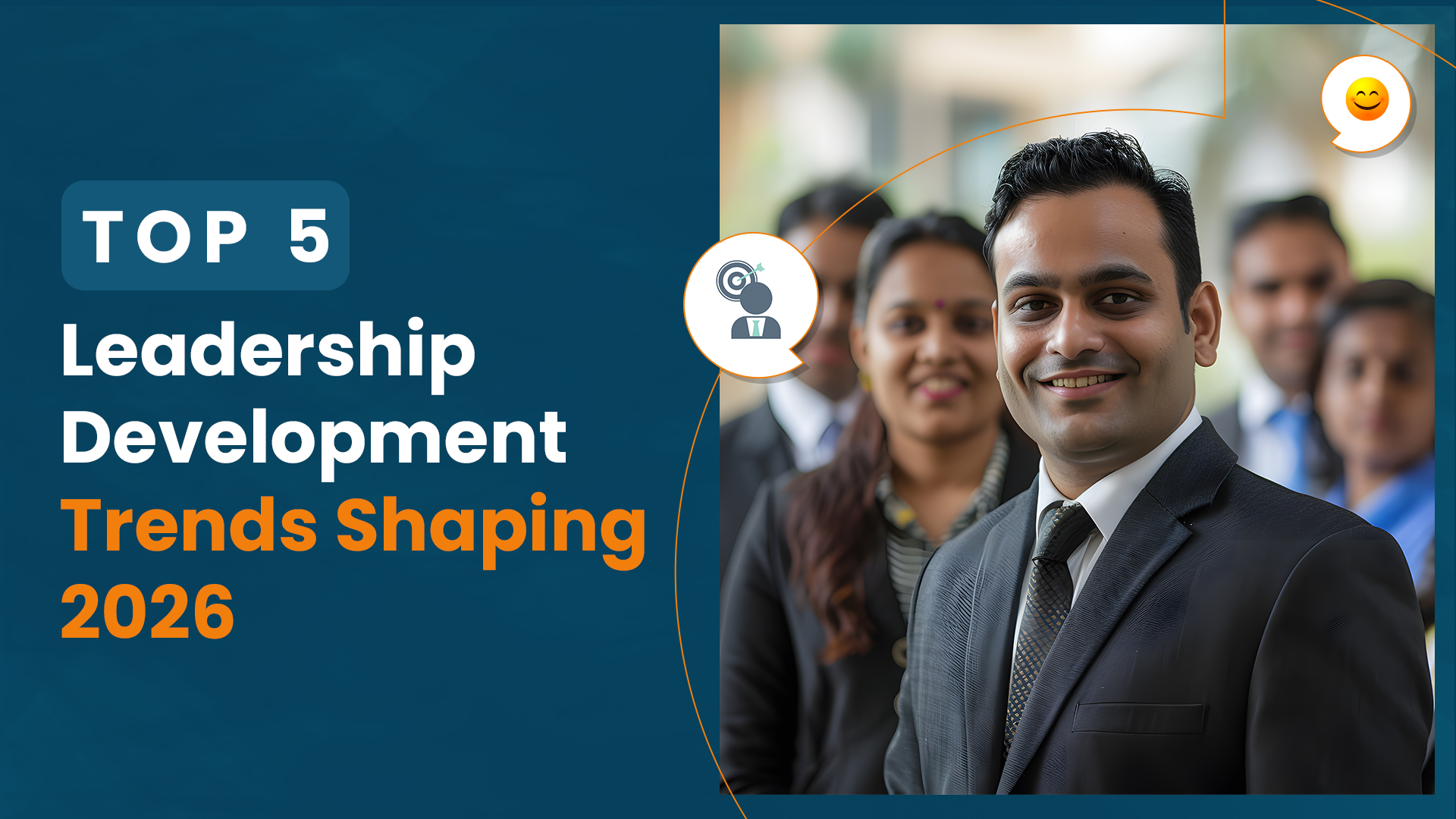
Leader and manager development is the number one priority for HR in 2025 and beyond. This isn’t just about upskilling — it is about survival. Leadership development must move from generic programmes to precise, high-impact, transformation-led interventions for leaders to stay relevant in the evolving future of work.
Here are the six definitive trends shaping leadership development for 2026.
Artificial Intelligence is no longer a future consideration. It is embedded in decision-making, operations, customer experience, and talent management — making AI fluency a non-negotiable leadership capability in 2026.
Gartner predicts over 75% of organisations will shift from piloting AI to operationalising it at scale by 2026. McKinsey highlights the rise of agentic AI systems that can plan, execute, and optimise complex tasks autonomously — evolving from tools into digital collaborators.
- Decision-making cycles will shrink dramatically
- Leaders must merge intuition, data, and scenario modelling
- AI will identify risks earlier and opportunities faster
- Ethical AI use becomes a leadership responsibility, not an IT concern
- AI literacy for leaders (comprehension, not coding)
- Predictive insight interpretation
- Ethical AI frameworks
- Decision intelligence simulations
AI won’t replace the leader — but leaders who don’t learn to collaborate with AI may find themselves outpaced by those who do.
Even as AI scales efficiency, human capability becomes even more critical. Organisations are realising that only leaders can scale what technology cannot — trust, belonging, motivation, culture, and resilience.
Human-centred leadership grounded in empathy, emotional intelligence, and psychological safety will be one of the most valuable forms of leadership in 2026. This evolution is driven by hybrid and distributed teams, growing generational diversity, rising burnout, and employee expectations for meaningful, coaching-led leadership.
Leaders who succeed will demonstrate:
These human qualities will differentiate high-performing organisations from those that rely solely on process and efficiency.
Leadership development used to mean the same training modules for everyone, delivered annually or quarterly. But leadership growth is inherently personal. What one leader needs is not what another requires.
In 2026, organisations are shifting to individualised leadership development journeys supported by diagnostics, behavioural insights, and adaptive learning tools.
Development journeys built around each leader’s specific role, gaps, and growth stage — not a generic curriculum.
Intelligent platforms that surface the right content, coaching, and challenges at the right time for each individual leader.
Short, focused learning interventions embedded into the flow of work — not pulled out for quarterly sessions.
Growth tied directly to observable performance outcomes — measuring behaviour change, not just course completion.
As leaders are expected to transition faster, work across disciplines, and adapt to constant change, personalised development ensures the right capability is built at the right time — enabling leaders to grow beyond narrow functional roles.
Leadership maturity is no longer defined by expertise alone, but by the ability to navigate complexity, manage decision fatigue, and develop others in real time. As work becomes more ambiguous and hybrid models reduce informal learning, leaders are increasingly expected to coach — helping teams think clearly, adapt quickly, and build capability through everyday interactions.
Lasting behavioural change requires sustained reinforcement and safe spaces for honest reflection. Coaching and mentorship provide that structure, enabling leaders to test ideas, sharpen their thinking, and grow in step with accelerating organisational change.
Forward-thinking organisations are building:
The organisational model of 2026 is not hierarchical — it is networked. Companies are moving toward agile, cross-functional, project-based structures where leadership flows fluidly based on strengths, not seniority.
The conversation around artificial intelligence has shifted from “What can it do?” to “What can’t it do?” In 2026, that question has become irrelevant. The real question is: how fast can you deploy AI agents before your competition does?
“Agents have the potential to automate complex business processes combining autonomy, planning, memory and integration to shift genAI from a reactive tool to a proactive, goal-driven virtual collaborator.”
Agentic AI represents the next evolutionary leap — moving beyond simple automation to create digital employees that think, plan, and execute complex business processes independently. This isn’t about replacing human creativity or strategic thinking. It’s about freeing your best people from the operational quicksand that drowns productivity and stifles innovation.
- Leaders must learn to identify which processes are ripe for agentic AI deployment
- Orchestrating AI agents becomes a core leadership and management competency
- Human effort concentrates on creativity, judgment, relationship-building, and strategy
- The competitive gap between AI-ready and AI-hesitant organisations will widen rapidly
Leadership as a Core Transformation Capability
In 2026, leadership development will no longer be confined to HR or L&D ownership. Instead, it will be recognised as a core enterprise capability that determines an organisation’s ability to adapt, compete, and transform at speed. The trends shaping leadership today signal a fundamental shift: from developing individual leaders to building organisational leadership systems.
MARG Business Transformation works with organisations at precisely this inflection point. Our leadership programmes are designed to move beyond skill enhancement and focus on enterprise readiness — ensuring leadership capability is directly aligned with strategy execution, operating model shifts, and long-term value creation.
Through MARG’s transformation-led approach — including our work as a Prosci Change Management Authorised Partner in India — leadership development:
In a world where transformation is continuous, leadership effectiveness cannot be episodic. It must be systemic, measurable, and sustained. Organisations that treat leadership development as a strategic transformation lever — rather than a periodic training intervention — will be the ones that navigate uncertainty, scale innovation, and outperform in the decade ahead.
MARG partners with organisations to institutionalise this shift — building leadership architectures that do not merely respond to change, but drive it.
Ready to Future-Proof Your Leadership Pipeline?
Talk to MARG about designing a leadership development strategy that is aligned to where your organisation is going — not where it has been.
Talk to MARG →