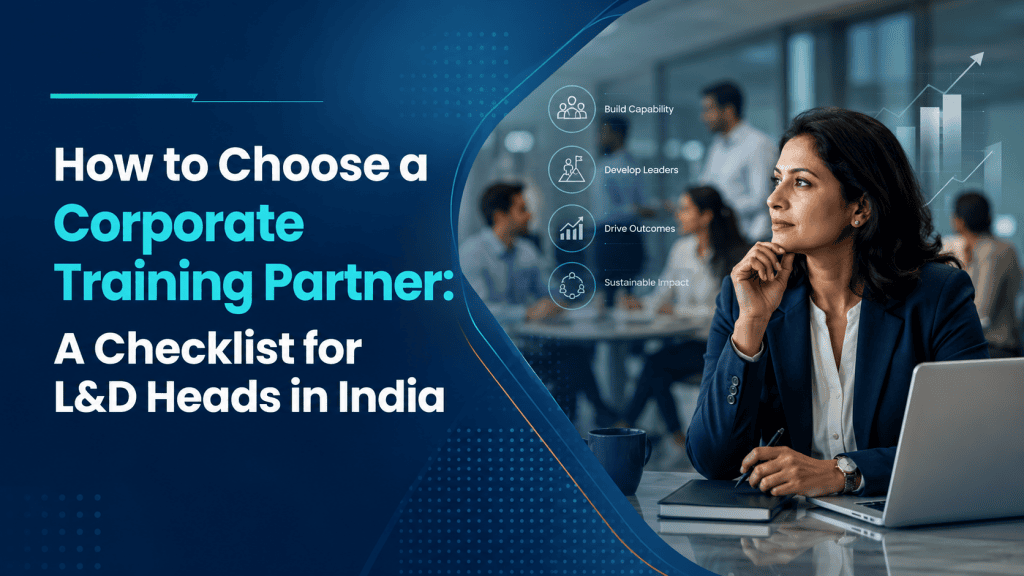
- Corporate training in India is shifting from a support function to a strategic business driver aligned with measurable outcomes.
- The best corporate training companies in India focus on business problems, not generic course delivery.
- Customization, industry expertise, and trainer quality significantly impact learning effectiveness and adoption. ROI must be measured across learning, behaviour, and business performance metrics.
- A strong corporate training partner in India enables long-term capability building, not just one-time training events.
India's workforce is growing rapidly, but skill readiness is not keeping the same pace. Businesses are hiring more people, expanding into new markets, adopting digital tools, and redesigning the way work gets done. However, many employees are still struggling to match the speed at which roles, technologies, customer expectations, and leadership demands are changing, which is why demand for corporate training companies in India is rising.
This skill gap is now becoming a serious business concern. Organisations need employees who can think critically, collaborate better, use digital systems confidently, manage clients effectively, and adapt to change without constant supervision. They also need managers who can lead hybrid teams, coach people, handle performance conversations, and support transformation without creating resistance.
This need is giving rise to corporate training in India. Corporate training helps organisations improve employee skills, productivity, compliance, leadership capability, and workplace performance in a structured way. It helps businesses build a workforce that is not only skilled for current responsibilities but also ready for future demands.
The India corporate training market reached USD 12.2 billion in 2025 and is expected to grow to USD 39.9 billion by 2034, showing how strongly organisations are investing in capability building.
But as demand grows, the number of corporate training companies is also increasing. This gives L&D teams more choices, but it also makes selection more difficult. Because not every corporate training provider can understand business context, customise learning, measure outcomes, or support behaviour change after the session ends. L&D heads need to evaluate partners carefully.
The following checklist will help L&D teams identify the best corporate training company in India for their organisation's needs and build a stronger, more outcome-focused L&D strategy.
10-Point Checklist to Choose the Right Corporate Training Partner from Top Corporate Training Companies in India
Use this corporate training partner checklist to evaluate different corporate training companies objectively. This list will help you identify a partner who can understand business needs, strengthen employee capability, and support a long-term L&D strategy.
Start with Business Alignment, Not Training Topics
Many organisations start their corporate programmes with themes or topics including leadership, communication, emotional intelligence, sales excellence, presentation skills, team building, or change management. These topics are important, but they are only useful when they are connected to a clear business need.
A credible corporate training partner in India helps translate business goals into learning objectives. If the business goal is improving customer experience, the training must focus on listening, empathy, problem-solving, ownership, escalation handling, and service recovery. If the goal is building future-ready managers, the training must focus on delegation, coaching, feedback, performance ownership, and team motivation.
Look for Deep Customization
Customization is one of the biggest differentiators among corporate training companies. A ready-made workshop may cover general concepts, but it will fail to address the actual behaviour gaps within an organisation. Employees may enjoy the session, but they may not learn how to apply the learning in their daily work.
A quality partner tailors content for every role, level, function, and business context instead of delivering the same deck to every prospect. Their leadership development programme for first-time managers will not look the same as a programme for senior leaders. First-time managers will be supported in shifting from individual contribution to team management. They'll learn how to delegate, give feedback, conduct one-on-one conversations, and manage team accountability.
Senior leaders will be supported for deeper work around strategic alignment, influencing across functions, leading change, decision-making under uncertainty, and building leadership culture.
Evaluate the Partner's Understanding of Human Behavior
This matters because real learning is not just about giving employees more information. It is about helping them understand themselves, work better with others, and apply new behaviours in real business situations.
Many times, employees understand a concept during the session, but they may not apply it consistently afterward. A leader may learn the importance of change communication but still communicate too late or too vaguely.
The training partner should know how adults learn, how behaviour changes, how resistance shows up, and how reinforcement improves retention. They should be able to design sessions that include reflection, discussion, real scenarios, practice, feedback, and action planning.
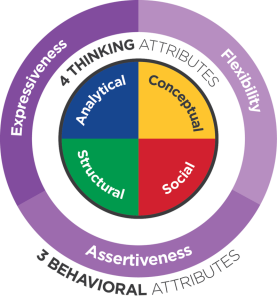
MARG strengthens this aspect through its partnership with Emergenetics International, a neuroscience-based, research-backed psychometric assessment. Emergenetics® helps individuals and teams understand thinking and behavioural preferences, making it easier to improve communication, collaboration, leadership awareness, and team effectiveness.
Check Trainer Quality and Facilitation Depth
The trainer is one of the most important parts of the learning experience. A well-designed programme can still fail if the facilitator lacks depth, energy, practical experience, or the ability to connect with learners.
Good trainers do not simply present slides. They read the room, ask the right questions, bring examples from real business situations, manage discussions, handle resistance, and adapt the session based on learner needs.
When evaluating a corporate training partner in India, L&D heads should assess trainer capability carefully. Ask questions such as:
- Does the trainer have experience with similar organisations?
- Can they handle senior leaders as well as frontline teams?
- Do they understand the industry context?
- Can they facilitate discussions, not just deliver content?
- Can they work with resistance, silence, or difficult questions?
- Do they use practical exercises, case studies, and workplace scenarios?
The best trainers combine subject expertise with facilitation intelligence. They know when to explain, when to listen, when to challenge, and when to simplify.
Ensure the Program Supports Different Learning Formats
Modern organisations need flexibility in learning delivery. A single classroom format may not work for every company today. Many organisations have employees across different cities, branches, plants, business units, and time zones. Some teams work remotely. Some work in hybrid models. Some roles require on-site learning, while others can learn effectively through virtual sessions.
A capable partner should offer classroom, virtual instructor-led, blended, and self-paced options, so training remains accessible to teams across locations. This is especially important in India, where large organisations often operate across multiple cities, plants, branches, or remote teams, and a single format can reduce participation or completion.
Choose a Partner That Measures Real Impact
Many organisations still measure training success through attendance, completion, and participant satisfaction. But these metrics are not enough. A strong partner tracks pre- and post-learning improvement, on-the-job behaviour change, and business results such as quality, speed, revenue, or service scores.
L&D heads need to look for partners that measure learning at different levels.
- At a basic level, the partner should measure whether participants understood the concepts.
- At a deeper level, they should assess whether participants changed behaviour at work.
- At the business level, they should help track whether the programme contributed to improved performance outcomes.
The best corporate training companies help organisations define success before the programme begins. They create a measurement framework at the design stage itself.
Look for Reinforcement Beyond the Workshop
Training does not end when the session ends. In fact, that is when the real work begins.
Employees may feel motivated immediately after a programme, but daily work pressure can quickly pull them back into old habits. Without reinforcement, learning fades. Without manager involvement, application becomes inconsistent. Without follow-up, even strong programmes can lose momentum.
The good corporate training providers build reinforcement into the learning journey through coaching, manager toolkits, refreshers, action plans, and micro-learning nudges, because retention improves when learners revisit and apply concepts over time.
For leadership and change management programmes, reinforcement is especially important. Managers and leaders need repeated practice to build new behaviours. They also need support from their own managers and business leaders.
Assess the Partner's Ability to Scale
As organisations grow, training needs to scale across teams, functions, and locations. A strong corporate training partner in India should be able to run programmes for 50 learners today and 5,000 tomorrow without compromising quality, consistency, or reporting.
This becomes especially important for large Indian organisations with multiple offices, plants, business units, and regional teams. Scaling training across such environments requires more than trainer availability. It requires programme governance.
A scalable training partner should have:
- Clear learning design documentation
- Facilitator alignment processes
- Standardised delivery guidelines
- Localised examples where needed
- Batch-wise reporting
- Feedback analysis
- Quality assurance processes
- Leadership visibility into outcomes
Among enterprise L&D service providers, a partner that can scale well becomes a long-term capability-building ally, not just a short-term vendor.
Involve Managers and Leaders in the Learning Journey
Training works best when it is supported by the organisation's leadership ecosystem. If employees attend a programme but their managers never discuss the learning, encourage application, or review progress, behaviour change becomes difficult. Learners may return to the workplace with new ideas, but without reinforcement from managers, those ideas often remain unused.
A strong training partner should help organisations involve managers before, during, and after the programme. Before the programme, managers can help identify real challenges and expectations. During the programme, they can encourage participation. After the programme, they can support application through coaching, feedback, and review conversations.
Senior leaders also play an important role. When leaders visibly support a learning initiative, employees take it more seriously. Leadership alignment helps connect training to business priorities and creates accountability for change.
Evaluate Long-Term Business Value Over Cost
Price matters, but value matters more. A low-cost training provider may appear attractive at the procurement stage, but if the programme is generic, poorly facilitated, weakly measured, or unsupported after delivery, it can become expensive in the long run. Employees spend their time in training, managers lose productive hours, and the organisation still does not get meaningful improvement.
A strong partner may cost more, but can deliver better value through stronger diagnosis, customized design, expert facilitation, practical tools, measurement, reinforcement, and long-term capability building.
Conclusion
Choosing the right corporate training partner in India is one of the most important decisions an L&D leader can make. The right partner can help an organisation move from scattered training activities to a more strategic L&D strategy. It can help employees build practical skills, managers lead with more confidence, teams collaborate better, and leaders guide change more effectively.
But in a market filled with many corporate training companies, the best choice is the partner that understands the organisation's business reality and helps convert learning into performance.
For organisations looking for the best corporate training company in India, MARG is a corporate training consultancy that offers a credible, structured, and outcome-focused approach. With our expertise in leadership development, change management, team effectiveness, and the neuroscience-based tool Emergenetics®, MARG helps organisations build people capability with clarity, confidence, and measurable purpose.
Build a Training Programme That Delivers Results
Talk to MARG about a customised corporate training programme that strengthens your leaders, improves team performance, and supports long-term business growth.
Contact MARG Today