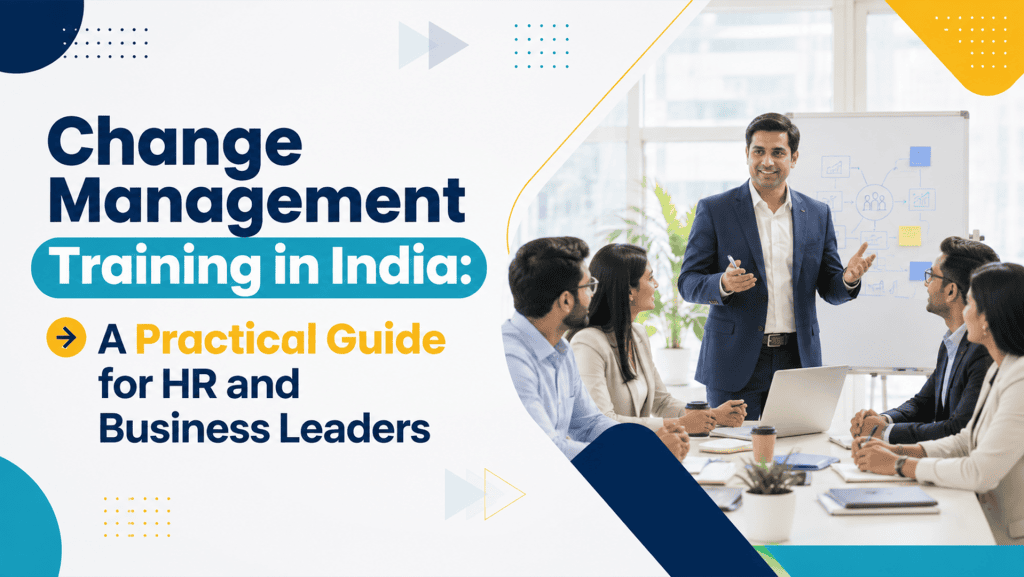
- Change management training equips leaders, managers, practitioners, and employees with the skills, tools, and shared language needed to guide people through change.
- A structured change management course or change management workshop helps organisations strengthen readiness, communication, resistance management, and adoption across organisational change management initiatives.
- With the right methodology and support from experienced teams or a change management consultant, organisations can improve project outcomes, build internal capability, and make change more sustainable over time at scale with measurable business impact.
Change management is the structured approach used to manage the people side of change. It helps organizations prepare, equip, and support employees so that new ways of working are not just introduced, but actually adopted. When change is managed well, it has a direct impact on employees, customers, productivity, profitability, and overall business outcomes. That is why change management training in India has become a priority for organizations navigating digital and enterprise transformation.
Research has consistently shown that organizations with excellent change management are 7X more likely to achieve successful project results. Change management training is no longer only important for change managers, but essential for sponsors, people managers, project teams, HR leaders, IT professionals, and employees who are expected to adopt new systems or processes.
The right organizational change management training helps individuals and organizations build the knowledge, tools, and confidence needed to manage change successfully. Whether the change involves a new technology, a process redesign, a restructuring, a merger, or a large-scale business transformation, people must understand what is changing, why it matters, and how they are expected to adapt.
Organizations with excellent change management are 7X more likely to achieve their project objectives than those with poor change management.
Why Change Management Training Matters
Training plays a critical role in helping people move from awareness to adoption. During a change initiative, organizations typically need two types of training.
1.) Functional training: This is training for employees or end users who need to learn how to use a new system, process, tool, policy, or way of working. For example, if an organization is implementing a new ERP platform, employees need practical training on how to complete their day-to-day tasks in the new system.
2.) Role-based change management training: This is training for the people responsible for leading, supporting, and enabling the change. It includes sponsors, people managers, change practitioners, project teams, and other leaders who must help employees move through the transition.
When employees do not receive adequate training, organizations often experience higher resistance, confusion, anxiety, disengagement, and a tendency to return to old ways of working. Training helps reduce these risks by building knowledge, confidence, and readiness. It also gives people in critical change roles a clear understanding of what they need to do to support adoption.
Who Needs Change Management Training?
Different audiences need different levels of change management training depending on their responsibilities, experience, and involvement in change initiatives.
1.) Change Management Practitioners
Many professionals begin with foundational change management training or a change management certification course. This helps them understand what change management is, why it matters, and how to apply proven methodologies and tools to real projects.
Foundational training is useful for professionals who are responsible for supporting or driving change across a team, department, or organization. This may include change leaders, project managers, change management practitioners, continuous improvement specialists, IT professionals, HR business partners, organizational development professionals, and project team members.
A strong introductory program typically covers the definition and value of change management, common models and methodologies, the roles needed for successful change, and practical tools for planning and execution.
2.) Advanced Change Management Practitioners
Once practitioners have experience with foundational concepts, they may need more advanced training to manage complex change initiatives or move into specialized roles.
Advanced practitioners can develop deeper skills in areas such as improving project health, preventing or managing resistance, resolving barriers to adoption, and monitoring change performance. These specializations help practitioners strengthen specific parts of the change process.
Some experienced practitioners may also choose a training specialization. This prepares them to facilitate change management programs internally and build change capability across teams. These professionals become important enablers when organizations want to scale change management knowledge across the business.
Another path is change capability or enterprise change management specialization. This is useful for leaders responsible for building change capability across a division or an entire organization. These professionals learn how to assess current change capability, define a future-state vision, and create a roadmap for building change-ready organizations. This type of training is especially relevant for HR leaders, IT leaders, strategy heads, change management practice leaders, and organizational directors.
3.) Sponsors and Senior Leaders
Sponsors play one of the most important roles in successful change. Prosci's benchmarking research has identified effective executive sponsorship as the greatest contributor to change success across nine studies.
Senior leaders are responsible for setting direction, building alignment, communicating the importance of the change, and reinforcing commitment. If sponsors do not understand their role, the change initiative can lose momentum. Sponsorship training helps leaders understand how to actively and visibly support change, communicate with employees, align leadership teams, and drive measurable outcomes.
4.) People Managers
People managers are close to employees and play a direct role in helping teams adopt change. They communicate the change, answer questions, provide support, coach employees, and identify resistance early.
Training for managers helps them prepare themselves first and then support their teams more effectively. It gives them practical frameworks and tools to guide conversations, address concerns, and help employees move through the transition with greater confidence.
5.) Project Managers and Project Teams
Project management and change management are complementary disciplines. Project management focuses on delivering the technical side of a project, while change management focuses on ensuring people adopt and use the solution.
Prosci benchmarking research shows that 47% of participants who integrated project management and change management reported meeting or exceeding project objectives. This was 17% higher than those who did not integrate the two disciplines.
For this reason, project managers and project teams benefit from change management training. It helps them understand how people-related risks affect project success and how to work more effectively with change practitioners.
6.) Employees and End Users
Employees and end users also benefit from training because they are the ones expected to work differently. Training helps them build the mindset, skills, and adaptability needed to navigate change. It also helps them understand what is changing, how it affects their role, and what support is available.
Core Components of Change Management Training
The content of a change management training program may vary depending on the course and audience. However, effective programs usually include several essential components.
1. Change Management Principles
A strong program begins with the fundamentals. Participants should understand the value of change management, the psychology of change, and why structured approaches improve the likelihood of success.
Training should also introduce proven methodologies such as the Prosci 3-Phase Process and the ADKAR Model. These frameworks give participants a practical way to manage change at both the individual and organizational level. They also provide structure while remaining flexible enough to adapt to different types of projects and business environments.
2. Role-Specific Training
Change management succeeds when the right people perform the right roles at the right time.
Executives need training focused on sponsorship, strategic alignment, leadership communication, and accountability. Managers and supervisors need training on team-level communication, coaching, and resistance management. Change practitioners need deeper training on applying change methodology, building plans, assessing readiness, and driving adoption.
Role-specific training ensures that everyone understands their responsibilities and how their role contributes to overall change success.
3. Practical Skill Development
Training should build practical skills that can be applied immediately. These may include communication planning, stakeholder engagement, resistance management, coaching, impact assessment, readiness assessment, and reinforcement planning.
These skills help participants move beyond theory and support real change initiatives. The goal is not just to understand change management but to apply it in day-to-day project and organizational settings.
4. Tools, Templates, and Resources
Effective training should give participants access to tools and resources that support change management execution. These may include assessment tools, stakeholder maps, communication plans, training plans, resistance management plans, and readiness checklists.
Hands-on practice is important. When participants use tools during training, they build confidence and are more likely to apply them after the program.
5. Evaluation and Feedback
Training programs should evaluate whether participants have understood and can apply what they have learned. This can include surveys, quizzes, discussions, practical exercises, or assessments.
Feedback also helps improve the training experience. When participants share what worked well and where they need more support, organizations can refine future learning programs.
6. Ongoing Support and Development
Change management capability cannot be built through one workshop alone. Ongoing support is important for reinforcing learning and encouraging application. This may include coaching, mentoring, online resources, refresher sessions, advanced learning, and access to practitioner communities.
Continuous development helps individuals grow from awareness to capability and from capability to mastery.
Choosing the Right Change Management Training Program in India
The right change management training program should give professionals and organizations more than conceptual knowledge. It should provide a proven methodology, practical tools, role-based learning, and continued support that can be applied to real change initiatives.
At Marg, we help professionals and organizations build this capability through a change management course in India, along with Prosci change management certification and training programs. As Prosci's authorized partner in India, we offer access to globally recognized change management learning that equips practitioners, sponsors, managers, and teams with the skills, tools, and research-backed approach needed to lead change more effectively.
For organizations looking to build broader change capability, Marg also supports corporate change management programs and enterprise change management solutions that help embed change management across teams, functions, and leadership groups.
Ready to Build Change Capability in Your Organisation?
Explore Prosci change management training and certification programs with Marg, Prosci's authorised partner in India.
Contact Marg Today