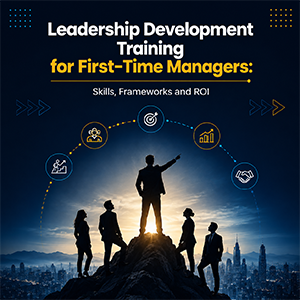
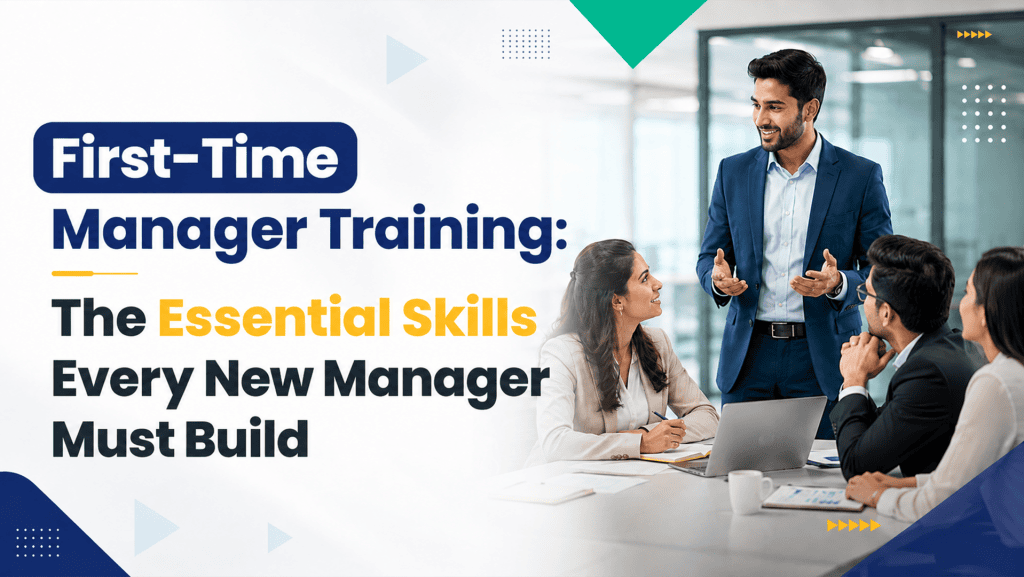
- First time manager training is critical to reduce failure rates, protect engagement, and avoid costly people-management mistakes.
- New manager training must focus on mindset shift, not just tools, moving from "doing" to "enabling others."
- Core first time manager skills should include communication, delegation, feedback, performance management, EQ, conflict resolution, time management, and coaching.
- A strong manager training program in India blends global best practices with local cultural realities and hybrid work.
- Continuous, blended leadership training for new managers builds a strong pipeline of people leaders and supports long-term business performance.
Becoming a manager is often seen as a natural next step for a high-performing employee. But the transition from individual contributor to manager is not as simple as a change in title, which is why first time manager training matters.
A new manager is no longer responsible only for personal output. They are now responsible for team clarity, motivation, performance, accountability, and development. They have to manage people who may have different working styles, different expectations, different levels of confidence, and different ways of responding to pressure. And this is where many first-time managers begin to struggle.
Research from the Center for Creative Leadership shows that around 60% of new managers never receive formal training when they step into leadership roles, and Gartner reports that 40% of managers struggle to support their team, largely due to a lack of structured development.
A well-designed new manager training program helps new leaders understand what has changed, what is expected from them, and how they can lead without losing themselves in pressure. It gives them practical tools to communicate clearly, delegate responsibly, manage performance, coach team members, and build trust.
But before building the skills every new manager needs, it is important to understand that the shift must happen at the mindset level.
From Individual Contributor to People Leader: Mindset Shift
Before becoming a manager, an individual's success often comes from personal expertise. The person is known for solving problems, completing tasks, meeting deadlines, and delivering quality work. They may be used to being the person others rely on. But once they become managers, the role changes.
They are no longer expected to be the only expert in the room. They are expected to create an environment where others can perform with clarity and confidence. And this is exactly where many first-time managers struggle.
In most manager training program in India, including first line manager training, the first big hurdle seen is "the mindset". As an individual contributor, success is about "my output"; as a manager, success is about "my team's output."
As a manager, success becomes collective. It is no longer only about "What did I complete?" It becomes "How well did my team perform?" Now, management, coaching, removing blockers, building trust, and helping someone improve should become their real work.
- From "doing the work" to "enabling others to do the work" through delegation and coaching
- From "being the expert" to "asking strong questions and facilitating problem solving"
- From "competing with peers" to "collaborating across functions and managing stakeholders"
- From "short-term tasks" to "balancing today's delivery with long-term capability building"
If this mental switch doesn't happen, even the best tools and frameworks remain underused.
Essential First Time Manager Skills Every New Leader Must Build
1. Communication that Aligns and Inspires
Communication is one of the most essential first-time manager skills because almost every management problem becomes worse when communication is unclear.
A new manager may know what needs to be done, but if the team does not understand the goal, timeline, quality expectation, priority, or decision boundary, execution will suffer. Good communication is not just about speaking well but creating shared understanding. New managers need to define what success looks like. They need to clarify who owns what.
This becomes even more important in hybrid and remote teams, where people may not have the benefit of informal office conversations. A vague message on chat can create confusion, and a poorly structured meeting can waste time.
Therefore, strong new manager training should cover different layers of communication, including:
- Setting clear expectations
- Running focused team meetings
- Conducting meaningful one-on-ones
- Listening actively
- Communicating across email, chat, and video calls
- Adapting communication to different personalities
- Giving context before assigning tasks
In India, where teams often mix different languages, cultures, and levels of hierarchy sensitivity, leadership training for new managers must also address how to give feedback respectfully while still being direct and outcome focused.
2. Delegation and Trust-Building
Most professionals think delegation means assigning tasks. But true delegation is about transferring ownership with clarity, support, and accountability.
Many new managers struggle to delegate because they believe it is faster to do the work themselves, or they worry that the team members will make mistakes. Yet efficient delegation is core to every successful manager training program in India and worldwide.
Effective delegation requires four things:
- The manager must define the expected outcome. The team member should know what needs to be achieved, not just what activity needs to be completed.
- The manager must explain the context. People make better decisions when they understand why the task matters.
- The manager must set checkpoints. This helps avoid last-minute surprises without turning into micromanagement.
- The manager must allow room for learning. If every task must be done exactly the manager's way, delegation becomes control in disguise.
Delegation is not just a productivity tool, but also a development tool. When managers delegate thoughtfully, they help employees build confidence, judgment, and readiness for larger responsibilities.
3. Giving and Receiving Feedback
Feedback is often cited as one of the most stressful and the most avoided parts of new manager training, but it is also one of the most powerful performance levers.
New managers often fear feedback conversations because they do not want to sound harsh. They may give general comments like "be more proactive" or "improve quality" without explaining what specifically needs to change. This does not help the employee.
Effective first-time manager training helps leaders:
- Deliver regular, specific, behaviour-based feedback instead of vague labels
- Separate "the person" from "the behaviour" to protect psychological safety
- Invite upward feedback to improve their own leadership habits
Studies on high-performing cultures consistently show that teams with strong feedback habits adapt faster and retain top talent longer, which is especially critical in competitive Indian sectors like IT, BFSI, and e-commerce.
4. Performance Management and Difficult Conversations
It is easy to manage when everyone is performing well. The real test begins when someone misses deadlines, shows poor ownership, resists feedback, or creates tension within the team.
Many first-time managers either avoid these situations or react too late. By the time they address the issue, frustration has already built up.
Modern leadership training for new managers therefore includes:
- Setting SMART goals aligned with organisational priorities
- Translating annual targets into quarterly and monthly milestones
- Holding structured performance conversations with data, not emotion
- Addressing underperformance early with clear plans and support
Given that poor management is linked to higher turnover and massive economic impact, structured performance management is a critical priority for any first-time manager training curriculum.
5. Emotional Intelligence and Self-Awareness
Technical skills can help a person become a manager, but it is emotional intelligence that helps them become an effective one.
Emotional intelligence (EQ) consistently emerges as a predictor of leadership success in many researches. For new managers, EQ is what enables them to read the room, stay composed under pressure, and respond instead of reacting. This is why first-time manager training must include self-awareness.
Leadership training for new managers should help them:
- Recognise their emotional triggers and stress patterns
- Develop empathy for different working styles and life stages
- Balance task focus with genuine care and support in conversations
In Indian workplaces, emotional intelligence is especially important because teams often include different generations, regional backgrounds, communication styles, and hierarchy expectations. A manager who can combine warmth with clarity is more likely to build trust across these differences.
6. Conflict Resolution and Stakeholder Management
Conflict is inevitable whenever humans work together. First-time managers need to learn how to identify conflict early. They need to distinguish between task conflict and relationship conflict.
If a team disagrees about how to solve a problem, the manager can facilitate discussion. But if two people stop collaborating because of unresolved tension, the manager must intervene differently.
New managers are not only managing their direct team. They are also managing expectations from senior leaders, clients, cross-functional teams, and other departments. They need to know how to negotiate timelines, communicate risks, push back respectfully, and align people who may have different priorities.
A strong manager training program in India should include practical frameworks for conflict resolution. Without this skill, managers become trapped between pressure from above and frustration from below.
7. Time Management and Prioritization
Many new managers feel busier than ever after promotion. Their calendar fills with meetings; team members need support; senior leaders need updates, or escalations come unexpectedly. This creates an overload.
Effective leadership training for new managers should teach prioritization as a core management capability. New managers must learn how to decide what deserves their attention and what does not.
- They need to separate urgent work from important work.
- They need to create time for thinking, reviewing, coaching, and planning.
- They also need to protect their team from unnecessary chaos.
The best leadership training for new managers must explicitly teach how to:
- Block time for deep work, 1:1s, and team reviews
- Prioritise using frameworks like "urgent vs important"
- Say "no" or "not now" gracefully while still supporting stakeholders
Strong time management cascades to the team, shaping norms around responsiveness, focus, and work-life balance.
8. Coaching and Developing Others
A manager's role is not only to get work done. It is also to help people grow. This is one of the most meaningful parts of management, but it requires patience and skill.
Coaching is different from giving instructions. When a manager instructs, they provide an answer. When a manager coaches, they help the employee think better.
For example, instead of immediately solving a problem, a manager may ask:
- "What options have you considered?"
- "What do you think is blocking progress?"
- "What support do you need?"
- "What would you do differently next time?"
These questions help employees build judgment. Over time, they become less dependent and more capable.
How MARG's First Time Manager Training Helps Build Confident Managers
First-time managers need more than generic leadership advice. They need structured support that helps them handle real management situations with confidence, clarity, and consistency.
MARG works with organisations to build practical manager training programs in India that prepare new managers for the everyday realities of leading people. We focus not only on teaching leadership skills, but on helping managers apply them in conversations, decisions, reviews, feedback discussions, and team situations.
Through our leadership development, first line management training, and corporate training expertise, MARG helps new managers build core capabilities such as communication, delegation, feedback, performance management, coaching, conflict handling, emotional intelligence, and stakeholder management.
The learning experience can include interactive workshops, role plays, reflection exercises, group discussions, real workplace scenarios, and action planning. This helps managers practice difficult conversations before they face them on the job.
If you are looking to strengthen the leadership pipeline at your organisation, MARG's training for first time managers can help reduce the risks of unprepared management.
Ready to Build a Stronger Leadership Pipeline?
Schedule a call with MARG to design a first-time manager training programme built for your teams.
Schedule a Call