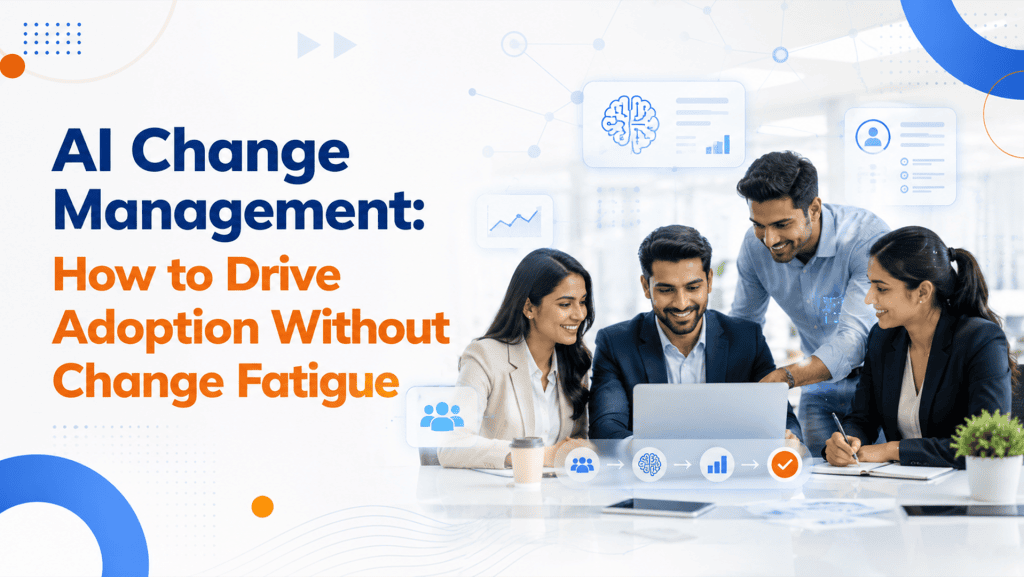
AI change management is the structured process of helping employees understand, trust and use AI tools in their daily work, so that AI investment turns into measurable business results.
It matters because most organizations now use AI somewhere, yet far fewer have scaled it, and the gap is usually people-side: unclear purpose, generic training, overloaded teams and managers left without answers.
This article explains why AI adoption stalls, how fatigue builds, and five steps CHROs and transformation leaders can use to pace AI rollouts, build trust, measure real usage and align managers, using the Prosci ADKAR model as the backbone.
- AI change management is a people-first process, ensuring technology integrates into workflows while reducing resistance, skepticism, and adoption gaps.
- Structured change adoption relies on role-based training, leadership alignment, pacing, and reinforcement to prevent fatigue and support confidence in AI tools.
- Effective AI adoption requires measurable outcomes, clear governance, trust-building, and continuous learning, enabling employees to embrace AI responsibly, enhance productivity, and drive sustainable business results.
Did you know that only 12% of organizations have fully implemented AI technologies at scale, even though 80% are experimenting with them? That gap is not a technology problem alone; it is an AI change management problem, and one that organizations scaling AI, including AI change management in India, must address deliberately.
From predictive analytics and automation to generative AI tools, companies are exploring AI to improve efficiency, decision-making, and business outcomes. Yet, many organizations discover that these initiatives are creating more friction than progress when change is treated as an afterthought. The hardest part is not deploying the tool; it is getting people to trust it, use it, and integrate it into daily work.
Employees may experiment with AI, but without a clear purpose, role-based training, and visible support from leaders; AI usage stays shallow, and enthusiasm fades. This is where a structured AI change management approach makes the difference between a tool that gets tried once and one that becomes part of daily work.
Why does AI adoption stall in enterprises?
AI adoption stalls when organizations treat AI as a software installation instead of a change to how people work. Unclear purpose, generic training and fear about roles lead employees to try the tool once and return to old habits.
AI often fails to deliver because organizations treat it like a software installation instead of a business transformation. Research and industry analyses consistently show that adoption breaks down when leaders ignore readiness, workflow impact, and employee concerns.
This happens because AI changes more than tools. It changes decision-making, job roles, approval paths, service delivery, and performance expectations. For employees, that can feel like extra work layered on top of existing responsibilities, especially if the business case is unclear or training is generic.
At a psychological level, AI adoption often triggers uncertainty, not logic-based rejection. Employees may worry that AI will reduce their control over decisions, expose gaps in their skills, or make their expertise feel less valuable. When leaders announce AI only in terms of speed and efficiency, people can interpret that message as a threat to their identity, not an opportunity for growth.
What is change fatigue in AI adoption?
Change fatigue is the exhaustion and disengagement employees feel when too many changes arrive at once, without time to recover or see benefits. In AI programmes it shows up as skepticism, passive resistance and silent non-adoption.
Change fatigue builds when people are asked to absorb too many changes at once, without enough time to recover or see the benefit. In AI projects, this often shows up as skepticism, passive resistance, or silent non-adoption. Teams may attend the training, but they return to old habits because the new process feels harder, riskier, or less relevant.
This is especially dangerous in enterprise environments, where change fatigue in digital transformation gets worse when automation rollouts, compliance changes, and AI pilots all arrive at the same time
How do you drive AI adoption without change fatigue?
Start with a clear business problem, build trust early, pace the rollout, measure adoption from day one and equip managers to coach. These five steps keep the load on employees manageable while usage grows.
These five steps are practical AI adoption strategies for enterprises that want results without overloading their people.
1. Start with the Business Problem
Successful AI adoption begins with a clear understanding of the problem to solve, the users affected, and the expected outcomes. Employees are more likely to embrace AI when they understand the why before the how.
For example:
- Introducing AI to reduce manual data entry in finance highlights time savings and reduced errors.
- Using AI to support supply chain forecasting shows practical improvements in planning accuracy.
Leaders should define success in business terms rather than technical milestones. Saying "we deployed an AI tool" is less compelling than "we reduced processing time by 40%" or "we improved forecast accuracy by 30%." Clear outcomes help employees see tangible benefits, reducing resistance, and building momentum.
2. Build Trust Early
Trust is the foundation of AI adoption. Employees need to believe that AI is useful, reliable, and aligned with their work objectives. When fear or uncertainty arises, such as concerns over job security or output accuracy, adoption slows. That is why transparency matters. Employees should understand:
- What AI does and does not do
- The data sources and decision-making logic
- Where human judgment remains critical
Include frontline users early in the design and testing process so they can flag workflow issues before rollout. A small group of champions can be far more effective than a company-wide announcement because peers are often more credible than executives.
Training should also be role-specific:
- Managers need guidance to coach teams through change
- End users require workflow-specific instructions
- Support teams need clear escalation protocols
According to Prosci, 38% of AI adoption challenges stem from insufficient training, reinforcing the need for practical enablement rather than one-time awareness sessions.
3. Reduce Overload with Pacing
One of the most effective ways to avoid change fatigue is to pace the rollout. Do not launch every AI use case at once. Start with one or two high-value processes, stabilize them, and then expand.
This approach helps in three ways:
- It gives employees time to learn without overload.
- It creates visible wins that build confidence.
- It lets leaders fix problems before they spread.
Recovery time matters too. When teams are already dealing with new tools or policy changes, adding another major initiative can create burnout. In enterprise settings, especially after In enterprise settings, especially after ERP or process modernization efforts, sequencing is as important as speed. Adoption improves when people have time to absorb, practice, and adapt.
4. Make Adoption Measurable
What gets measured gets managed. AI change management should include adoption metrics from the beginning, not just project delivery metrics.
Useful measures include:
- Active usage rate
- Task completion time before and after AI support
- Percentage of users trained and certified
- Employee sentiment and confidence scores
- Reduction in manual effort or rework
- Exception rates and escalation trends
These metrics tell you whether the change is actually sticking. If usage is low, the issue may not be the model itself; it may be training, workflow design, or trust. Measuring adoption early helps leaders intervene before frustration turns into fatigue.
5. Align Leaders and Managers
Executives set direction, but managers drive behavior. If middle managers are not aligned, adoption slows quickly. They become the people employees turn to when something feels confusing or risky, so they need clarity, support, and consistency.
Leaders should model the change visibly. That means using the AI tools themselves, talking about lessons learned, and reinforcing that adoption is part of performance, not an optional extra. Managers should be equipped with talking points, escalation steps, and coaching guidance so they can reinforce the message in daily work.
This is where many programs fail: leadership announces the change, but management is left to interpret it. That gap creates noise, hesitation, and resistance. Strong change management closes that gap with repetition, clarity, and support.
Why is the human side central to AI change management?
Because AI only creates value when people use it in daily work. Communication, role-based training, sequencing and listening turn AI from a source of fatigue into a source of productivity.
AI may be advanced, but driving technology adoption still depends on human behavior.
The most effective organizations treat AI change management as an ongoing capability, not a one-time rollout. They communicate early, train by role, sequence carefully, measure adoption, and listen continuously. That combination turns AI from a source of fatigue into a source of productivity.
For organizations in India that want to scale AI responsibly, the answer is not more pressure. It is better change design. A structured approach such as Prosci's ADKAR framework can help leaders build awareness, desire, knowledge, ability, and reinforcement in a way that supports adoption without overwhelming people. Used well, it helps teams embrace AI with confidence instead of fatigue.
Marg, as an authorized Prosci partner in India, offers guidance and training on the ADKAR model to help organizations implement AI adoption successfully., offers guidance and training on the ADKAR model to help organizations implement AI adoption successfully. Contact Marg to learn how your team can leverage Prosci's proven framework for sustainable results.
How can Indian enterprises use Prosci ADKAR for AI adoption?
ADKAR guides each employee through Awareness, Desire, Knowledge, Ability and Reinforcement. As an authorized Prosci partner in India, MARG applies it to AI rollouts so adoption grows without overwhelming teams.
Talk to a Prosci ADKAR Expert