- Research from Gartner indicates that over 70% of newly implemented ERP initiatives are expected to fall short of their original business objectives by 2027.
- ERP resistance stems from communication gaps, role uncertainty, transition fatigue, and undertrained employees — not just technology aversion.
- The Prosci ADKAR® model provides a structured, individual-level framework — Awareness, Desire, Knowledge, Ability, Reinforcement — that bridges implementation and real business value.
- Role-based, scenario-driven training is more effective than generic system walkthroughs for building confident ERP users.
- Reinforcement after go-live — recognition, check-ins, usage metrics — is what prevents adoption from fading and old habits from returning.
- A structured five-step rollout plan aligned to ADKAR makes ERP change management measurable and sustainable.
ERP adoption is often positioned as a technology upgrade, but in practice it is a shift in how the organisation operates at every level. ERP systems bring structured data, integrated workflows, and real-time visibility, which directly improve decision-making and operational control.
However, these benefits are realised only when employees consistently use the system as intended. And this is where most ERP programmes face challenges, which is why the ADKAR model for ERP implementation has become a practical way to manage the people side of the change.
By 2027, over 70% of newly implemented ERP initiatives are expected to fall short of fully achieving their original business objectives — largely because organisations underestimate the human side of the transition.
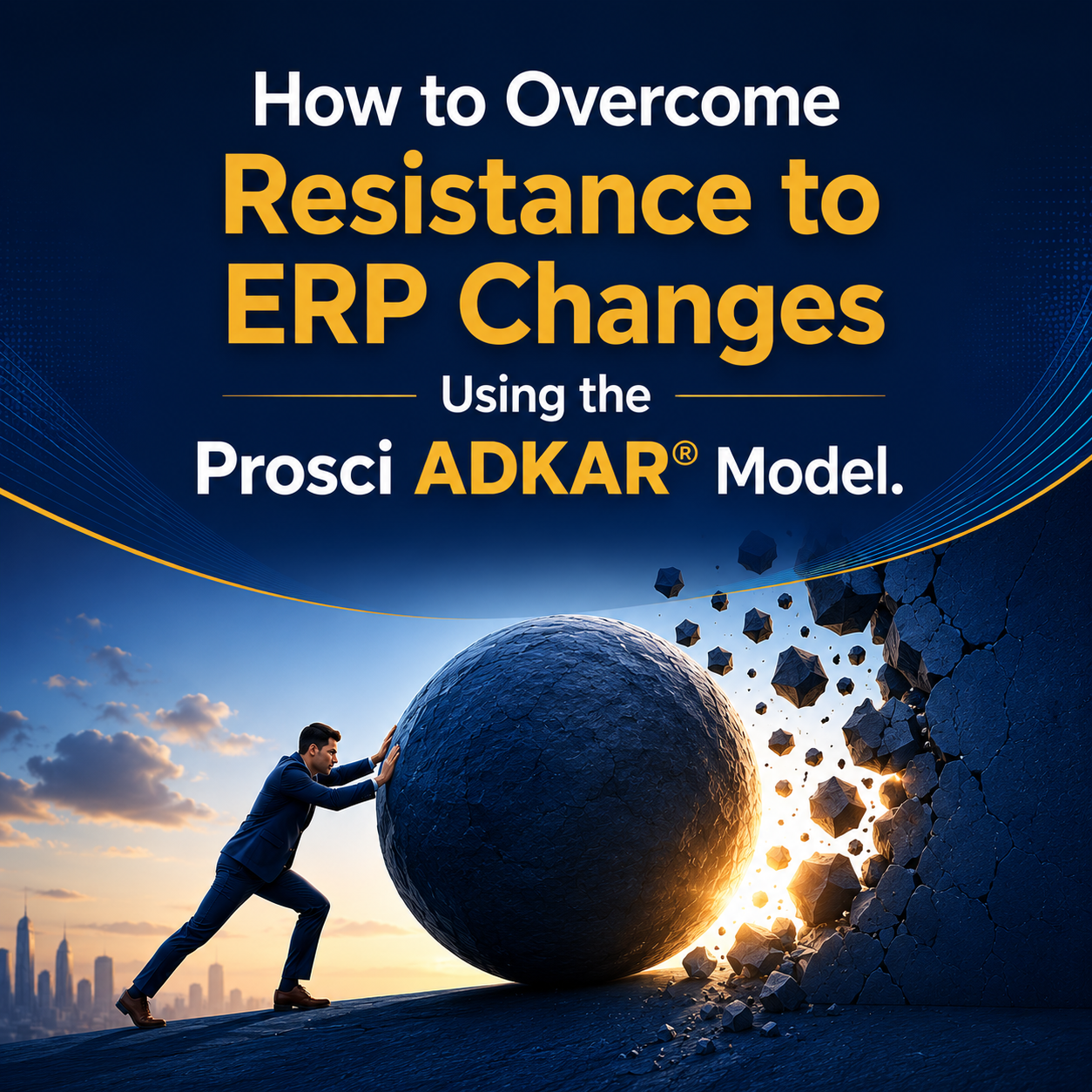
When organisations ignore the human side of ERP rollouts, the result is often low adoption, workarounds, confusion, and delayed value realisation. In this article, we explore why ERP change management must be treated as a business priority and how the Prosci ADKAR® model can help overcome ERP resistance.
Why ERP Change Gets Resisted
ERP transformations create resistance because they disrupt established ways of working. Unlike isolated system upgrades, ERP impacts multiple departments simultaneously, making the change both broad in scale and personal in impact.
Employees are not just learning a new system; they are being asked to rethink how they perform their roles, interact with other teams, and manage their responsibilities. This transition happens while they are still expected to deliver on their existing workload, which adds pressure and increases the likelihood of resistance.
Key reasons ERP change gets resisted
- Communication gaps breed distrust. When messaging is inconsistent or delayed, employees don't just lack information — they fill the void with worst-case assumptions about intent and impact.
- Uncertainty about roles and relevance. Standardised processes can shift responsibilities and reduce autonomy, leaving employees unsure of where they fit in the new landscape.
- Ambiguous performance expectations. A new system often changes how work is measured. Even strong performers can feel unsettled when the goalposts aren't clearly redefined.
- Transition fatigue. Running business-as-usual while learning a new system is a real operational burden. Resistance is often exhaustion presenting itself as pushback.
- Undertrained and underconfident. Generic or compressed training leaves employees afraid of making mistakes — so they avoid the system rather than risk visible failure.
These factors collectively make managing resistance in organisations a critical part of ERP programmes. If not addressed early, they lead to low system usage, process inconsistencies, and reliance on workarounds.
How the ADKAR Model for ERP Implementation Helps You Overcome Resistance
The Prosci ADKAR® model works well in ERP environments because it focuses on adoption, not just project delivery. ADKAR stands for Awareness, Desire, Knowledge, Ability, and Reinforcement, and this ADKAR change management framework gives leaders a practical sequence for helping people move through change.
That sequence matters because ERP adoption happens at the individual, role, and team level. A project can be technically on track and still fail operationally if users do not adopt the new processes in a consistent way. The ADKAR® model becomes a bridge between implementation and real business value.
System readiness and user readiness are different. People need to understand what is changing, see why it matters to their work, build confidence with new processes, apply them in real situations, and receive the support needed to make the new way of working stick. ERP change management should therefore be built around the way people actually experience disruption.
Building Awareness: Explain Why the ERP Change is Happening
The first breakdown in most ERP programmes happens at the very beginning. Organisations announce the implementation, but they do not clearly explain why it matters in practical terms. Employees hear that a new system is coming, but they do not see how it connects to their daily work.
Awareness helps employees understand why the ERP system is being introduced and what problem it solves. If this step is weak, people often fill the gap with rumours, assumptions, and resistance. Building effective awareness requires communication to be consistent, contextual, and repeated across multiple channels.
- Explain the purpose clearly: Communicate why the ERP is being implemented, what problems it solves, and highlight current inefficiencies — manual workarounds, fragmented data, delayed reporting — in simple, non-technical language.
- Make it relevant to employees: Connect ERP benefits directly to daily tasks by showing how better data integration and streamlined processes will make their work easier and more efficient.
- Highlight the risk of not changing: Clearly explain the consequences of not adopting ERP, including compliance risks, lack of visibility, and operational delays that can impact business performance.
- Use structured and consistent communication: Leverage multiple channels — town halls, team meetings, emails, videos, internal platforms — and equip managers with toolkits and FAQs to ensure consistent messaging across all levels.
- Reinforce and build trust over time: Repeat key messages regularly and maintain alignment between leadership, project teams, and managers so employees hear a consistent narrative, making the change feel credible and less threatening.
Desire: Connect the Change to Personal Value
Desire is often the most difficult part of overcoming resistance to change using ADKAR because people rarely adopt change just because it is logical. They adopt it when they believe it matters to the business and when they can see what is in it for them. That is why leaders should speak about both organisational outcomes and personal outcomes.
For example, an employee may not care that the company wants standardised workflows, but they will care if the new ERP reduces repetitive data entry, cuts rework, and makes approvals faster.
Managers play a major role here. When the ADKAR® model is applied well, local managers are equipped to answer questions, acknowledge concerns, and translate the project into team-level benefits. When managers are visible and supportive, people are more likely to trust the change and participate in it.
It also helps to involve employees early. Invite input on pain points, process design, and testing priorities. People who help shape the future are much more likely to support it.
Building Knowledge: Teach the New Way of Working
Training is one of the most effective solutions to adoption challenges. However, most training programmes focus only on system navigation rather than process understanding. Employees need to understand new workflows, responsibilities, controls, and how their role connects with other functions across the organisation. Without this clarity, even well-designed ERP systems fail to deliver expected outcomes.
- Focus beyond system navigation: Training should explain end-to-end business processes, not just how to use the interface.
- Clarify role-level impact: Help employees understand what changes in their day-to-day responsibilities and decision-making.
- Show cross-functional dependencies: Explain how one team's actions affect others within the ERP system.
Role-based learning becomes critical at this stage. Finance teams need training on entries, approvals, reconciliations, and period-end processes. Operations teams need practice with production, inventory, or procurement scenarios. HR, sales, and admin users need guidance tailored to their actual tasks rather than generic system demos.
To strengthen knowledge effectively, organisations should adopt a blended learning approach:
- Classroom sessions: Build foundational understanding of processes and system logic.
- Guided walkthroughs: Demonstrate step-by-step execution of key workflows.
- Job aids and quick references: Provide easy-to-access support for daily tasks.
- Sandbox environments: Allow users to practise without risk to live data.
- Process maps: Visualise how activities flow across departments.
The ADKAR® model is most effective when paired with hands-on, scenario-based learning. When training reflects real business situations rather than abstract concepts, employees build confidence, retain knowledge longer, and are more likely to adopt the new way of working.
Developing Ability: Turn Learning into Performance
This is the stage where many ERP programmes face the most friction. Employees may have attended training, but that does not mean they can execute tasks confidently. Ability must be built through practice, coaching, floor support, and guided problem-solving until users can complete the process without constant help.
This phase is crucial in managing resistance in organisations because many people resist what they do not feel competent doing. If users struggle with system navigation, data entry validation, or understanding process dependencies, adoption breaks down.
- Build ability through structured practice: Use sandbox environments, UAT scenarios, and role-based simulations aligned with real business cases.
- Enable floor-level support: Deploy super users and SMEs during hypercare to resolve issues in real time and reduce dependency on IT teams.
- Introduce performance checkpoints: Track metrics like transaction accuracy, cycle time, error rates, and report usage to measure adoption.
The Prosci ADKAR® model encourages leaders to treat Ability as a measurable outcome. If employees cannot complete transactions accurately, approve requests on time, or use the right reports, then adoption is incomplete even if the system is live.
Reinforcement: Ensuring Adoption Does Not Fade
ERP change management must continue well after go-live. Reinforcement is what keeps the change from fading after launch. Without reinforcement, users often drift back to spreadsheets, side systems, or old approval paths because those habits feel easier under pressure.
Reinforcement can include recognition for early adopters, manager check-ins, performance scorecards, refresher sessions, and issue-resolution reviews. It should also include listening mechanisms so the project team understands where users are still struggling.
Prosci's research shows a strong link between measuring change-related compliance and project performance. Organisations that measure compliance and overall performance are significantly more likely to meet or exceed their objectives than those that do not.
Reinforcement also supports overcoming resistance to change because it signals to employees that the new way of working is now the normal way of working. When leaders keep supporting the change after launch, adoption is more likely to last.
A Practical Rollout Approach Using the Prosci ADKAR® Model
A strong ERP change programme should follow a structured rollout plan aligned with the Prosci ADKAR® model:
Clearly explain why the ERP change is required. Link the change to business problems such as fragmented data, manual processes, reporting delays, compliance gaps, and poor cross-functional visibility.
Identify each affected user group, their current workflows, expected process changes, and likely resistance points. This supports the Awareness and Desire stages of ADKAR.
Create training paths based on job roles, transactions, approvals, reports, and system responsibilities. This strengthens the Knowledge stage by making learning practical and task-specific.
Deploy super users, floor support, help desks, manager check-ins, and escalation channels. This helps convert training into Ability, where users can perform new processes confidently.
Track usage, process compliance, issue resolution, and user feedback. Recognise adoption, conduct refresher sessions, and correct workarounds. This completes the Reinforcement stage.
This approach makes ERP change management measurable, practical, and sustainable — ensuring the Prosci ADKAR® model is used as an execution framework, not just a planning concept.
Conclusion
ERP success is not just about going live with a system. It comes down to whether people actually understand the change, use the system correctly, and stick to new ways of working over time.
If you are planning an ERP transformation, it helps to work with experts who understand this deeply. MARG, as the official Prosci partner in India, brings practical ADKAR training and change management guidance to help teams reduce resistance and make change actually work on the ground. We support organisations through complex transitions by aligning leadership, managers, and teams around a structured change approach.
Frequently Asked Questions
Ready to Make Your ERP Programme Stick?
MARG is India's official Prosci partner. We help organisations build ADKAR-led change strategies that reduce resistance and drive real adoption — not just go-live.
Talk to Our Change Management Team →