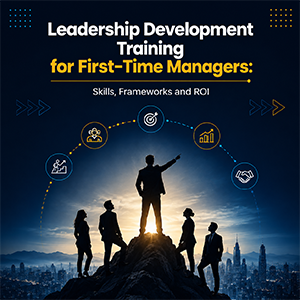

- The shift from individual contributor to manager most often fails around four predictable challenges: loss of professional identity, managing former peers, balancing tasks and people, and a lack of psychological safety.
- A reliable training framework rests on four phases — Preparation, Skill Acquisition, Application, and Sustainable Reinforcement — built to prevent the common "90-day drop-off."
- 1:1 coaching personalises group training to each manager's specific team context, whether they lead a remote team or a local one.
- Organisations that invest in structured first-time manager training see stronger retention, deeper succession pipelines, and more consistent culture.
The promotion from individual contributor to manager is perhaps the most significant transition in anyone's professional career. It is a moment of excitement and professional validation, but also a moment of intense vulnerability. While specific expertise may have driven success in the past, leadership demands an entirely new set of competencies, ones that revolve around people, decision-making, and organizational alignment.
Organizations frequently elevate their top performers only to find that these newly minted leaders lack the people-centric competencies required to effectively manage, motivate, and mentor. This "sink or swim" approach to promotion is a primary driver of leadership failure.
To mitigate this risk, building a robust first-time manager training framework has become a critical business imperative. At MARG Business Transformation, we believe that equipping first-time managers for success requires a deliberate, structured approach that treats leadership as a learned behavior rather than a natural gift.
By implementing proactive manager training programs, organizations can resolve the most common first-time manager challenges before they escalate into systemic issues, ensuring that their emerging leaders are prepared to drive both team engagement and organizational growth. But before we learn how to design effective leadership training for new managers, it is important to first understand the reality of this role-transition.
Why First-Time Managers Struggle
A new manager is no longer responsible only for their own output; they are responsible for the collective output of a team. This introduces a complex set of first-time manager challenges that, if left unaddressed, can lead to burnout, micro-management, and team disengagement.
The Loss of Professional Identity: Many new managers struggle with the transition from being the person who "does the work" to the person who "enables the work." For example, an expert software developer who was promoted for their coding speed may find it agonizing to watch a junior team member struggle with a problem they could solve in five minutes. If they do not learn to step back, they fail to coach their team, ultimately becoming a bottleneck rather than a leader.
Managing Former Peers: This is arguably one of the most delicate social dynamics in the workplace. Consider a marketing associate promoted to lead their former project team. They must suddenly balance friendly rapport with the need to hold colleagues accountable for deadlines. If they lean too far into "friendship," they fail to drive performance; if they lean too far into "authority," they risk alienating the very people they rely on for support.
Balancing Tasks and People: The most persistent temptation for a new leader is to prioritize immediate, tangible task completion over the intangible, long-term needs of team members. A manager might spend all their time finishing a client project themselves, while neglecting to provide the one-on-one coaching their direct reports desperately need to grow. In this case, they successfully complete one task, but they fail their team, causing long-term stagnation.
Lack of Psychological Safety: Fear is a powerful deterrent to organizational success. Many new managers fear that giving tough feedback will make them "the bad guy," or they fear receiving feedback because it might highlight their own insecurities as a leader. This hesitation creates a vacuum where communication stops, small problems fester into massive conflicts, and innovation is stifled because team members no longer feel safe sharing ideas or admitting mistakes.
Without structured manager training programs, these new leaders often fall back on the only leadership style they know, mostly of their own past managers, for better or worse. But there is a solution. By implementing proactive first-time manager training, organizations can break this cycle and replace guesswork with proven management methodologies.
The Role of Behavioral Science in Management
Leadership is, at its core, the study and mastery of human behavior - understanding how people think, respond, collaborate, and perform under different situations.
A first-time manager is not only responsible for their own output; they are expected to influence team performance, manage emotions, resolve conflicts, communicate clearly, and build trust across teams. That's why effective training for new managers cannot rely only on theoretical leadership concepts or generic soft-skills sessions.
New managers need structured learning that helps them understand workplace behaviors, improve decision-making, and apply leadership skills consistently in real situations.
At MARG, leadership development programs for first-time managers are designed around practical behavioral development rather than one-time classroom instruction.
The focus is to help new managers successfully transition from individual contributors to leaders through experiential learning, guided practice, coaching, and continuous reinforcement. The approach focuses on building capabilities that directly influence day-to-day managerial effectiveness, including:
Application-based learning is a major focus of the best manager training programs. Managers are placed in realistic workplace scenarios such as handling underperformance, navigating cross-functional disagreements, managing deadlines, or responding to team resistance. Feedback though coaching conversations, peer learning, and reflective practice ensures that learning translates into consistent managerial behavior, instead of remaining limited to workshop discussions.
A Comprehensive Success Framework for First-Time Managers
An effective training framework for new leaders should be divided into four distinct phases: Preparation, Skill Acquisition, Application, and Sustainable Reinforcement.
Preparation
Before the first training module begins, there must be absolute clarity regarding role expectations. Organizations must define what success looks like for a manager at the 30, 60, and 90-day marks. This preparation phase is the foundation of high-impact leadership development for first-time managers. When managers know exactly what is expected of them, they are less prone to the anxiety-driven behaviors that define many first-time manager challenges.
Skill Acquisition
In this phase, we move into the core curriculum. Effective training for new managers must cover a specific, non-negotiable set of skills:
- Advanced Communication: How to hold difficult conversations, lead meetings, and speak to groups.
- Delegation and Trust: Understanding how to assign tasks without falling into the trap of micromanagement.
- Performance Management: The art of delivering feedback that builds confidence rather than breaking spirits.
- Conflict Management: Learning to view friction as an opportunity for growth rather than a threat to team harmony.
Application
Theory without practice is inert. Our manager training programs emphasize experiential learning. We use real-world scenarios, such as managing a team member with performance issues or navigating a cross-functional project disagreement, to help managers build practical management instincts and confidence in handling workplace situations.
Sustainable Reinforcement
The most significant failure point in corporate training is the "90-day drop-off," where managers revert to their old behaviors. We prevent this by embedding coaching, peer-to-peer exchange, and continuous feedback loops into our leadership development for first-time managers. This reinforcement stage ensures that the first-time manager training creates permanent shifts in organizational culture.
Solving First-Time Manager Challenges Through Coaching
While group training provides the baseline, 1:1 coaching acts as the accelerant. Every new leader has unique strengths and blind spots. A skilled coach can help them translate the lessons from the manager training programs into their specific team context. For instance, a manager leading a remote, global team will have different needs than one leading a local, office-based group.
Personalized coaching ensures that training for new managers is relevant, actionable, and immediately applicable. It also provides a safe, confidential space for managers to discuss their struggles, fears, and successes, which is vital when navigating the isolation that often accompanies a promotion.
Building a Culture of Feedback and Openness
A key pillar of our leadership development for first-time managers is the normalization of the feedback loop. Many new managers feel that providing feedback is a form of criticism.
Our training reframes feedback as a developmental gift, a necessary component of professional growth. By teaching managers how to give constructive, empathetic, and objective feedback, we build stronger, higher-performing teams.
Simultaneously, we teach managers how to solicit feedback. A leader who is willing to ask their team, "What can I do to support you better?" instantly builds trust and psychological safety. This mindset shift is the defining characteristic of high-performing leaders, and it is a central goal of our manager training programs.
Long-Term Benefits for the Organization
When an organization treats first-time manager training as a strategic investment, the organizational ripple effects are profound.
Higher Employee Retention
Turnover is rarely just an HR issue. It is often a reflection of leadership quality, where employees disengage not from the organization itself but from ineffective management. When teams are led by trained and empathetic managers, they experience lower attrition because expectations are clear, communication is consistent, and individuals feel genuinely supported in their roles, which directly improves long-term retention.
Stronger Succession Pipelines
Organizations that invest in leadership development for first-time managers create a structured pathway for growth, ensuring that leadership readiness is not left to chance. By consistently developing managerial capabilities, companies build a dependable internal talent pool, reducing reliance on external hiring and ensuring smoother transitions into senior roles when the need arises.
Improved Cultural Consistency
A standardized approach to manager training programs ensures that leadership behaviors are not fragmented across departments but aligned with a common set of principles. This consistency strengthens organizational culture by embedding shared values around feedback, accountability, and communication, creating a more cohesive and predictable work environment.
Investing in Your Future
The transition of an employee into a manager is not just a job change, but a significant life change. By providing the right support, resources, and first-time manager training, you can ensure that this transition is a success for the individual and the organization alike.
At MARG Business Transformation, we partner with you to design training for new managers that is tailored to your unique culture, challenges, and goals. Our programs move beyond the classroom to drive real behavioral change, empowering your new leaders to step into their roles with confidence, clarity, and conviction.
Ready to Build Your Next Generation of Leaders?
Don't leave the success of your new managers to chance. Equip them with the tools, mindset, and confidence they need to lead effectively. Let's talk about designing a leadership journey that delivers measurable results.
Talk to MARG →