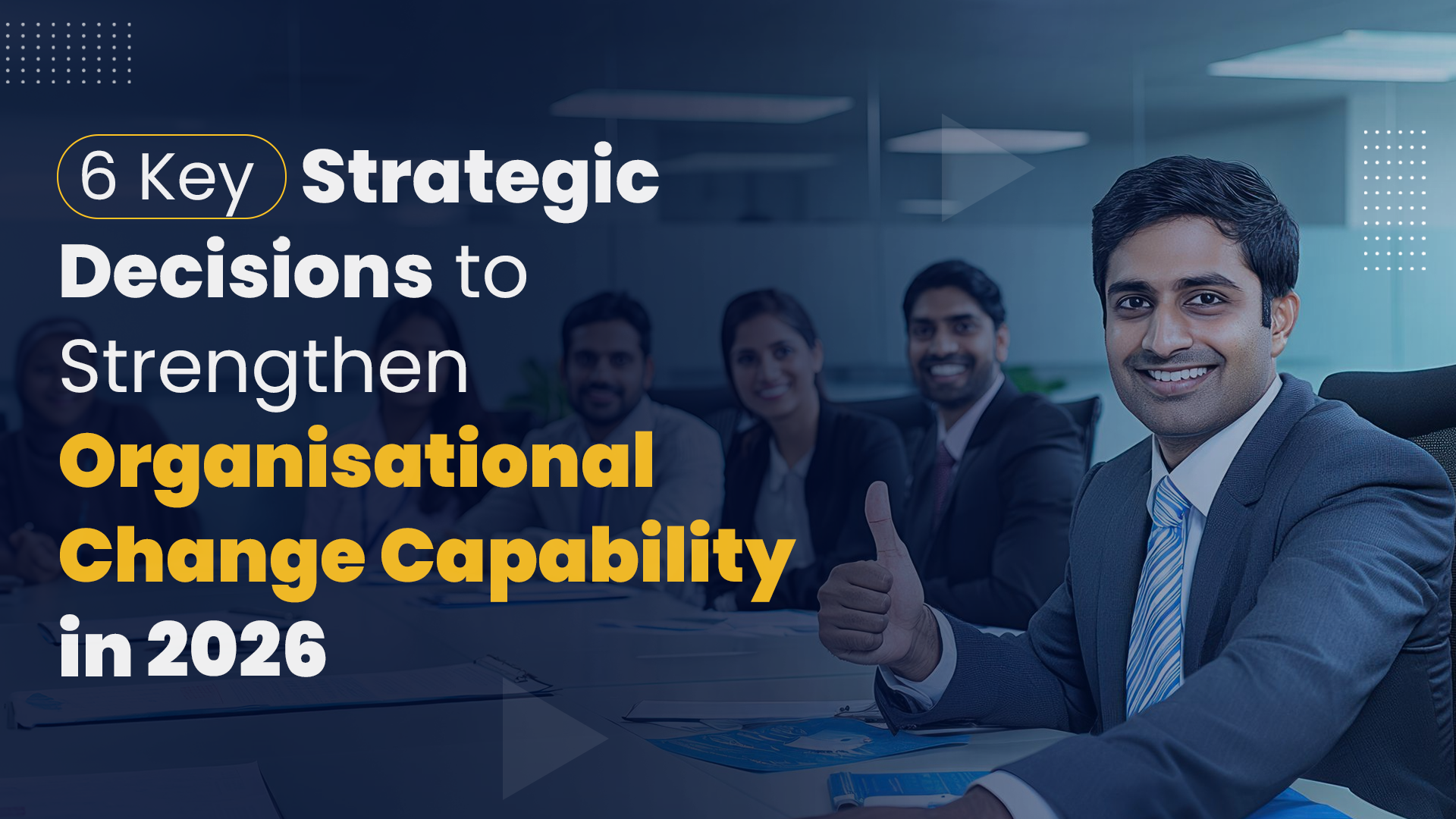
As we approach 2026, business leaders face an unprecedented challenge: managing transformation in an era where change isn’t just constant, it’s accelerating. Organisations that thrive won’t be those that simply react to change, but those that build robust organisational change capability as a strategic advantage.
The data tells a compelling story. Companies with mature change management practices achieve 88% success rates on their initiatives, while those without struggle at just 13%. With AI and digitalization sparking multiple overlapping transformations, now is the time to make deliberate strategic decisions that position your organization for sustained success in 2026 and beyond.
Here are five critical decisions that will separate change-ready organisations from those left behind.
1. Fund Change Capability Like Infrastructure, Not Projects
Shift from treating change management as a variable project expense to investing in it as core organizational infrastructure.
Most organisations approach change management backwards. They fund it project by project, treating it as an optional add-on rather than essential infrastructure. This creates a dangerous cycle: limited investment leads to poor outcomes, which reinforces the perception that change management doesn’t deliver value.
Organisations that invest in change capability as infrastructure see dramatic improvements. A difference that translates directly to bottom-line results. When change management is embedded in your organisational DNA, every transformation brings faster, more predictable outcomes, higher adoption levels, and increased ROI.
Action Steps:
● Establish a dedicated change management budget separate from project funding
● Build internal change capability through training and certification programs
● Create standardised change management processes and tools
● Measure and track change management ROI across all initiatives
2. Plan for Dual Transformation Realities
Develop separate strategies for managing continuous AI-driven change alongside discrete strategic projects.
The traditional model of managing one major transformation at a time is obsolete. Organisations now face dual realities: ongoing AI-driven operational changes that never stop, and strategic transformation projects with defined timelines. Each requires different approaches, resources, and mindsets.
AI and automation create continuous micro-changes in how work gets done. Simultaneously, organisations must execute major strategic initiatives. Without recognising these as fundamentally different types of change, leaders often spread resources too thin and fail at both.
Action Steps:
● Create separate change management streams for continuous vs. project-based transformations
● Develop “change stamina” programs to help employees adapt to ongoing evolution
● Establish different success metrics for continuous change (sustained adoption, user confidence, and incremental capability improvement) vs. project change (readiness milestones, stakeholder alignment, and benefits realization)
● Train managers to coach people through both types of change simultaneously
Also Read – Change Management is hard. Let’s make it easier
3. Embed Change Management Into Organisational Infrastructure
Make change management a core competency woven throughout your organization, not a specialised function.
Change management can’t remain the exclusive domain of a small team of specialists. When change capability lives only in a centralised function, it becomes a bottleneck. The most successful organisations distribute change management skills across all levels and functions.
Distributed change capability means faster execution, better local adaptation, and reduced dependency on external consultants. It transforms change from something that happens to your organisation into something your organisation does naturally.
Action Steps:
● Train all managers in basic change management principles
● Include change leadership competencies in performance reviews and promotion criteria
● Create change champion networks across departments
● Integrate change management methodologies into project management standards
4. Develop Leaders Who Are Change Capability Multipliers
Build leadership capacity to scale change adoption across the organisation.
Leadership today extends beyond delivering projects. Leaders are required to guide teams through continuous disruption while executing multiple transformation initiatives in parallel. Without strong leadership engagement, even well-designed change programs struggle to sustain momentum.
Change-capable leaders act as multipliers. Through visible sponsorship, coalition-building, and consistent communication, they accelerate adoption across initiatives without additional resources.
Action Steps:
● Equip leaders to act as active and visible sponsors throughout the transformation lifecycle
● Build cross-functional leadership coalitions to break silos and share accountability
● Train leaders to manage ongoing change alongside operational delivery
● Enable leaders to consistently communicate the “why,” “why now,” and “what if not” at key milestones
● Reinforce leadership behaviours that model adoption and reinforce desired outcomes
5. Measure Adoption in Real Time, Not Just at Project Completion
Track adoption continuously to protect investment and accelerate value realisation.
Transformation success depends on more than delivery. It depends on sustained adoption. Yet many organisations only assess outcomes at the end, limiting their ability to course-correct when resistance or disengagement emerges.
Real-time adoption measurement provides early visibility into risk, enables timely intervention, and strengthens confidence among senior stakeholders by demonstrating progress throughout the transformation journey.
Action Steps:
● Define clear adoption metrics aligned to business outcomes
● Establish real-time dashboards to monitor adoption and engagement
● Identify resistance early and intervene before issues compound
● Link adoption data to ROI indicators throughout the transformation lifecycle
● Use iterative insights to adjust change strategies and sustain executive support
Must Read – Is Change Management Certification Right for HR and L&D Leaders?
6. Build Adaptive Change Management Strategies
Develop flexible, responsive change management approaches that can pivot as circumstances evolve.
The pace of change means that transformation strategies must be adaptive by design. Linear, rigid change management approaches break down when market conditions shift, new technologies emerge, or organizational priorities evolve mid-stream.
Adaptive strategies allow organisations to maintain momentum even when the destination changes. They build resilience into the change process itself, reducing the risk of failure even when external factors shift.
Action Steps:
● Design change initiatives with built-in pivot points and decision gates
● Create scenario planning for major transformations
● Establish rapid feedback mechanisms to detect when course corrections are needed
● Train change teams in agile methodologies
● Build buffer capacity into change management resources
Build Your Change-Ready Organisation with Marg
Organisations that will lead the way in 2026 and beyond are making these strategic decisions now. They are not waiting for the next crisis to build change capability but investing in it as a competitive advantage.
The question is not whether your organisation will face significant change in 2026. The question is whether you will be ready to lead it, manage it, and profit from it.
The companies that treat organisational change capability as infrastructure, plan for dual transformation realities, and embed change management practices throughout their operations will write the success stories of tomorrow. Which story will your organisation tell?
In a world of continuous transformation, success depends on more than managing change. It requires building change capability as an organisational system. Marg Business Transformation the authorised affiliate of Prosci helps organisations embed change as infrastructure, strengthen leadership behaviours, and enable adaptive, data-backed transformation across the enterprise. The result is not one successful initiative, but a repeatable ability to execute change at speed and scale.
Partner with Marg Business Transformation to move beyond episodic change and build an organisation that can sense, adapt, and respond decisively, turning transformation from a risk into a sustained competitive advantage for the years ahead.