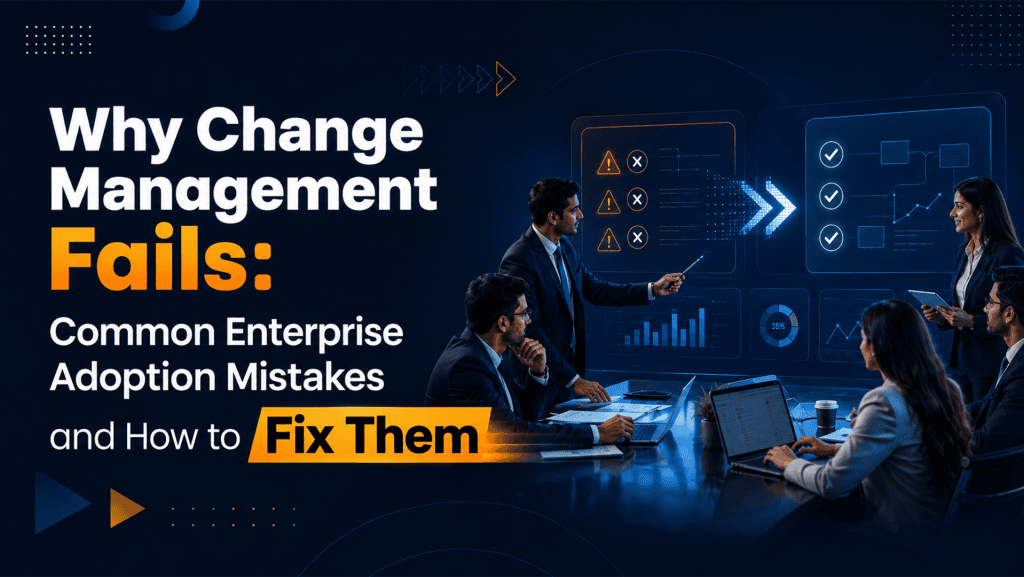
- Why change management fails: human factors are overlooked. Structured adoption ensures employees understand why, what, and how a change impacts their work, reducing resistance and fatigue.
- Tailored training, manager coaching, and phased rollouts build confidence, trust, and practical ability to integrate new ways of working into daily tasks.
- Continuous monitoring of adoption metrics, feedback, and reinforcement ensures sustained use, turning disruption into productivity and measurable business value.
Change is inevitable. But successful change — the kind that sticks — is rare, which is why change management fails so often in large enterprises.
Enterprise programmes generally manage two interdependent forms of progress. The first is technical progress: whether the new system, process, structure or policy has been designed and deployed correctly. The second is adoption progress: whether affected employees understand the change, support it, can perform in the new environment and continue using the new way of working after implementation. These outcomes are related, but they are not interchangeable.
A technically complete ERP implementation does not guarantee that finance teams will abandon spreadsheets. An AI platform deployment does not ensure that employees will trust or use its recommendations.
When programme governance tracks delivery without tracking adoption, the organisation discovers people-side problems only after go-live, when resistance, capability gaps and process deviations have already begun affecting performance.
Effective change management therefore requires a different operating question: "What must people understand, believe, learn and do differently for the transformation to produce its intended value?" That question should shape the Effective change management therefore requires a different operating question strategy from the beginning.
1. The Business Case Is Clear at the Top but Meaningless at the Role Level
Most transformations begin with a compelling enterprise rationale: reduce costs, improve customer experience, standardise operations, accelerate decision-making or build AI readiness. However, enterprise logic does not automatically translate into employee relevance.
While a transformation leader may understand why the organisation needs a shared services model, a frontline employee is more likely to ask:
- Which responsibilities will move?
- What decisions will I still own?
- How will my performance be evaluated?
- Will the new process increase my workload?
- Which existing skills remain relevant?
- What must I stop, start or continue doing?
When the organisation communicates only the strategic case, employees are left to interpret the personal consequences themselves. Rumour fills the information gap, managers create inconsistent explanations, and uncertainty becomes change resistance.
How to correct it
Translate the enterprise change narrative into clear, role-level implications through a structured change-impact analysis.
Assess how the transformation will affect responsibilities, decision rights, workflows, systems, skills, reporting relationships, stakeholder interactions, performance measures and incentives. For every affected employee group, clarify what is changing, why it matters and what people must do differently in their everyday work.
2. Sponsorship Is Treated as Executive Visibility Rather Than Executive Work
Many programmes claim to have leadership sponsorship because an executive approved the budget, launched the initiative or spoke at a town hall. That is not sufficient.
Effective sponsorship is an active governance role. Sponsors must repeatedly legitimise the change, align competing leaders, resolve organisational barriers, demonstrate the required behaviours and hold the business accountable for adoption.
This becomes especially important in matrixed enterprises, where a transformation may cross functions, geographies and reporting lines. Employees notice quickly when leaders describe the programme as critical but continue rewarding legacy priorities.
How to correct it
Define sponsorship through observable responsibilities rather than executive titles.
Sponsors must maintain a consistent case for change, align the leadership coalition, remove structural and political barriers, make timely decisions when adoption is at risk, model expected behaviours, review adoption indicators alongside delivery milestones and reinforce the change after implementation. They also require targeted coaching, as seniority alone does not guarantee the ability to address resistance, communicate uncertainty or influence behaviour across diverse stakeholder groups.
3. Change Impact Is Assessed Too Late or at Too High a Level
One of the most common enterprise adoption mistakes is to begin detailed people-impact assessment after the solution has already been designed. By that stage, key decisions about workflow, governance, controls and system configuration may be difficult to change. The change team is then asked to "manage resistance" to consequences it did not help identify or influence.
Another problem is excessive aggregation. An impact statement such as "sales will move to the new CRM" is not specific enough to support adoption planning. The real impacts may differ substantially:
- Account managers may need to record activities differently.
- Sales leaders may lose access to familiar reports.
- Operations teams may inherit new data-quality responsibilities.
- Regional teams may face changes to approval authority.
- Incentive calculations may depend on new data fields.
Without this level of analysis, communication remains generic, training becomes feature-led, and implementation risks are underestimated.
How to correct it
Treat impact assessment as an ongoing design discipline that begins during solution development and evolves with the programme.
Evaluate current and future ways of working, disruption levels, affected groups, required behavioural shifts, capability gaps, non-adoption risks, necessary interventions and readiness ownership.
4. Communication Is Used to Distribute Information, Not Create Understanding
Enterprise communication plans often measure activity: emails issued, town halls completed, intranet pages published and leadership videos released. These metrics confirm distribution, but do not ensure understanding.
Employees may have received the message without understanding the decision, believing the rationale or knowing what action is expected from them.
This is particularly relevant in complex transformations involving AI, automation, restructuring or new performance systems. The message may be technically accurate but still fail to address the questions driving employee behaviour.
How to correct it
Design change communication as an iterative process that builds understanding over time. Sequence messages around employee needs, distinguish confirmed decisions from unresolved questions, explain the rationale and trade-offs, and address role-specific concerns. Enable managers to discuss local implications and provide channels for feedback.
5. People Managers Become the Weakest Link in the Adoption Chain
People managers are frequently expected to interpret the transformation, answer employee questions, manage emotional reactions, maintain performance and reinforce new behaviours, all while adapting to the change themselves.
Yet they are often briefed at the same time as their teams. This creates a predictable failure point. Managers either repeat corporate messaging without context, delay conversations because they lack answers, or openly express their own doubts. Employees then receive different versions of the change depending on who manages them.
Because managers shape daily priorities, workload decisions and performance feedback, this inconsistency has a direct effect on employee adoption.
How to correct it
Treat manager enablement as a dedicated workstream by giving managers early access to the business rationale, team impacts, confirmed decisions, unresolved questions, employee concerns, conversation guides, escalation routes, coaching methods and adoption data. Managers also need time to process the change themselves. Their role is to translate enterprise change into local priorities, coach employees, and identify emerging adoption barriers. Understanding how team members think and communicate, for example through Emergenetics, helps managers tailor these conversations.
Want a structured plan to fix these change management pitfalls in your organisation?
Talk to MARG6. Training Is Designed Around the Solution Instead of the Work
Training frequently explains what the new platform can do but not how employees should use it within real operational conditions. This produces employees who have completed training but remain unable to perform confidently.
A feature-led system demonstration may show every available function. It may not teach an employee how to process an exception, resolve an incomplete data record, make a judgement call or coordinate with another team under the new operating model. Training completion therefore becomes a misleading readiness indicator.
How to correct it
Build learning around role performance by focusing on the tasks, decisions and scenarios employees will face after implementation. Combine scenario-based instruction, guided practice, simulations, workflow-based job aids, peer support, manager reinforcement and post-go-live refreshers.
Measure competency rather than attendance and time training close enough to deployment to support confident application without creating knowledge decay or operational risk. Practitioners who lead this work benefit from a structured change management certification programme.
7. Resistance Is Labelled as an Attitude Problem
When employees question a transformation, leaders may describe them as negative, inflexible or unwilling to change. This interpretation is usually too simplistic.
Resistance is information, and it often reveals the real barriers to change management. It may indicate a lack of understanding, a credible operational risk, loss of status, insufficient capability, change saturation, poor past experience or distrust of leadership. Not every objection is valid, but every pattern of resistance contains diagnostic value. For example:
- Repeated questions about roles may indicate unresolved organisational design.
- Avoidance of a new system may indicate capability or usability problems.
- Manager non-compliance may signal conflicting incentives.
Treating these signals as misconduct prevents the organisation from identifying their cause.
How to correct it
Segment resistance before responding by identifying whether it stems from limited awareness, low willingness, capability gaps, structural barriers, competing priorities, weak trust, change fatigue, design concerns or deliberate non-compliance. Each cause requires a different intervention.
8. Project Governance Tracks Delivery Risk but Not Adoption Risk
Most transformation governance is designed to monitor scope, budget, dependencies, technical defects and delivery dates.
People-side risks appear as secondary status updates, often expressed through broad categories such as "stakeholder engagement" or "training on track." This makes adoption difficult to govern.
By the time usage data reveals a problem, the programme may already have exited implementation, external partners may have rolled off, and business teams may be expected to absorb remediation costs.
How to correct it
Integrate change management directly into programme governance and evaluate adoption with the same rigour as technical delivery. Governance forums should review sponsorship, leadership alignment, business-unit readiness, manager capability, employee confidence, training proficiency, process compliance, system usage, workarounds, support demand, sentiment and business outcomes.
9. Go-Live Is Treated as the End of Change Management
Go-live is a technical milestone. For employees, it is often the beginning of the most demanding phase of the transition.
Before implementation, employees are learning conceptually. After implementation, they must perform under real deadlines, customer demands, incomplete information and unfamiliar processes. This is when old habits are most likely to return.
If reinforcement ends shortly after deployment, the organisation creates an environment where workarounds become normal, managers tolerate non-compliance and new processes gradually diverge across teams.
How to correct it
Create a defined reinforcement phase that monitors usage and compliance, provides performance support, schedules manager check-ins and refresher learning, recognises desired behaviours, and resolves recurring friction points. Retire obsolete systems, align measures and incentives, embed consistent processes through process excellence practices and address persistent non-adoption, and transfer ownership to business-as-usual teams.
10. Every Transformation Starts from Zero
Organisations that manage change only at the project level repeatedly rebuild the same basic capability.
Each programme creates its own templates, stakeholder maps, communication methods and training approach. Different business units use different terminology. Sponsors receive inconsistent guidance. Lessons remain within individual projects. This creates variable quality and slows transformation.
In an environment where organisations are managing multiple overlapping changes — — AI adoption, ERP modernisation, restructuring, regulatory shifts and new workforce models —, ERP modernisation, restructuring, regulatory shifts and new workforce models — project-by-project change management is no longer enough.
How to correct it
Build enterprise change capability by establishing a consistent methodology, role-based skills, standard tools, governance, communities of practice and portfolio-level visibility into change saturation. Organisations should also develop sponsors and managers, assess change maturity, integrate adoption into project, strategy and talent processes, and measure capability over time.
Why Change Management Fails Until Strategy Is Translated into Consistent, Everyday Behaviour
Enterprise transformation creates value only when employees adopt the processes, behaviours, systems and decisions required by the future state. Change management must therefore function as an integrated discipline connecting strategy, leadership, programme delivery, workforce capability and performance.
MARG Business Transformation helps organisations establish these conditions through through Prosci-aligned consulting, certification and role-based capability building., certification and role-based capability building. By strengthening sponsors, managers, practitioners and project teams, MARG enables organisations to overcome change management challenges such as resistance, improve adoption and embed change into everyday operations, building the internal capability required to deliver sustainable outcomes across repeated digital, AI, ERP and organisational transformations.
Ready to Turn Enterprise Change into Measurable Adoption?
Build the leadership, workforce capability and governance needed for transformation success.
Contact UsFrequently Asked Questions
Small teams can succeed by piloting initiatives, securing sponsor support, focusing on clear communication, targeting role-specific training, and scaling learnings gradually to influence wider organisational adoption.
Indicators include low employee engagement, repeated questions about purpose, passive resistance, inconsistent manager messaging, skipped training, slow adoption metrics, and negative sentiment in feedback or surveys.
Adoption metrics should be monitored continuously, with formal reviews weekly or biweekly early in the rollout, then monthly, to quickly identify gaps and adjust interventions effectively.
No. Technology facilitates change, but adoption depends on communication, leadership alignment, role-based training, pacing, and reinforcement to ensure employees trust, understand and integrate the change.
Organisations reduce resistance by clearly explaining the why, involving employees in planning, providing practical training, engaging managers as coaches, and addressing concerns about roles, workloads and outcomes early.