- Cognitive diversity helps leadership teams solve complex challenges by bringing together different ways of thinking, including logic, process, people focus, and big-picture ideas.
- Emergenetics gives leaders a practical framework to understand thinking and behavioural preferences, improving communication, collaboration, and decision-making.
- MARG, through its partnership with Emergenetics International, helps organisations build self-aware, high-performing teams through psychometric assessments, tailored workshops, and certification programmes.
Leadership teams are expected to solve problems that are rarely simple. They have to deal with market pressure, digital transformation, employee expectations, customer experience, financial risk, compliance, innovation, culture, and change, all at the same time. Yet many leadership teams try to solve these complex issues using a very narrow way of thinking, which is why cognitive diversity in leadership has become so important.
In some organisations, the loudest voice dominates the room. In others, decisions are shaped mainly by data, hierarchy, past experience, or urgency. Some teams move too quickly without thinking through the details. Some get stuck in analysis and never act. Some focus so heavily on people's feelings that the business problem remains unresolved. Others focus only on numbers and forget the human impact. This is where cognitive diversity becomes essential.
What is Cognitive Diversity
Cognitive diversity means differences in how people think, process information, solve problems, communicate, respond to uncertainty, and contribute to decisions. It is not just about having people from different backgrounds in the room. It is about making sure different thinking styles are heard, respected, and used.
For leadership teams, cognitive diversity can be the difference between surface-level decision-making and truly effective problem-solving. It can help leaders see risks earlier, explore new possibilities, make better decisions, and create stronger alignment across the organisation.
Emergenetics® offers a practical way to understand and build this kind of diversity. With Emergenetics®, leadership teams can learn how to use different thinking and behavioural preferences as a strength rather than allowing them to become a source of conflict.
Why Cognitive Diversity in Leadership Matters
Consider a company preparing for major digital transformation. The finance leader may focus on cost control, reporting accuracy, and risk. The HR leader may think about adoption, training, and employee anxiety. The CEO may want speed, business continuity, and strategic value.
All of these perspectives are valid. The problem begins when one perspective becomes the only perspective.
A leadership team that lacks cognitive diversity may miss important questions:
- Will employees actually adopt the new system?
- Are we moving too fast?
- Have we mapped the process dependencies?
- What risks are hidden in the data?
- How will this change affect customers?
- What does success look like after launch?
- Who needs to be involved before decisions are finalised?
When leadership teams include and use different thinking styles, they are better equipped to deal with complexity. They can look at the big picture, manage details, examine data, understand people, and adapt their behaviour based on the situation.
What Is Emergenetics®?
Emergenetics® is a neuroscience-based, research-backed psychometric assessment that helps people understand thinking and behavioural preferences. It looks at how people naturally prefer to think and behave, based on both life experience and inherent tendencies.
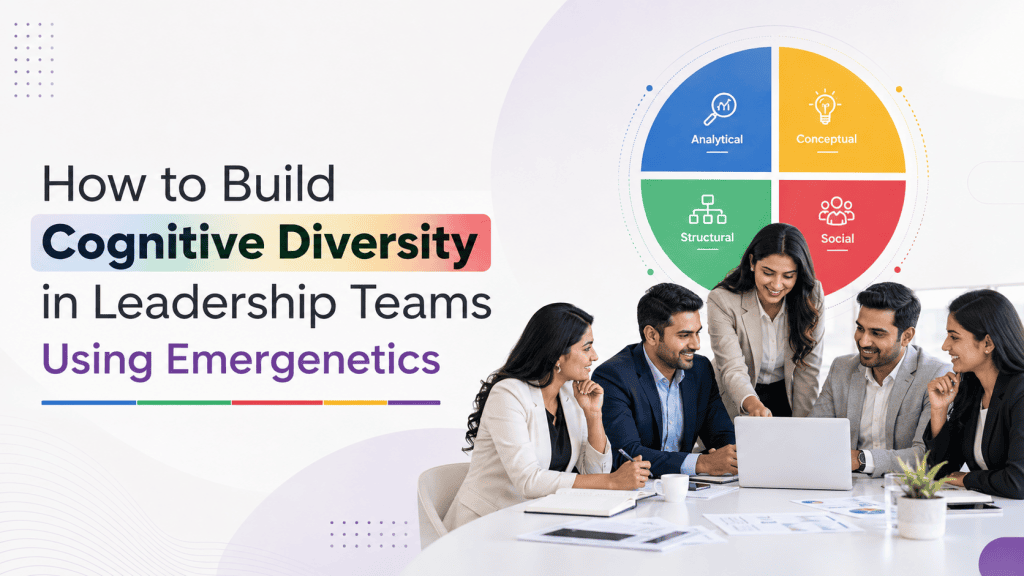
The Emergenetics Profile focuses on seven Attributes. These include four Thinking Attributes and three Behavioural Attributes.
The four Thinking Attributes are:
- Analytical Thinking
- Structural Thinking
- Social Thinking
- Conceptual Thinking
The three Behavioural Attributes are:
- Expressiveness
- Assertiveness
- Flexibility
Together, these attributes help explain how people approach problems, interact with others, make decisions, and contribute to a team.
The goal is not to label people or put them into fixed boxes. The goal is to help teams understand one another better. When leaders know how different people prefer to think and behave, they can create better conversations, reduce misunderstandings, and make stronger decisions.
The Four Thinking Attributes in Leadership Teams
Each Thinking Attribute brings a different kind of value to leadership decision-making.
1. Analytical Thinking: The Logic and Data Lens
Analytical thinkers naturally look for evidence, logic, facts, and objective reasoning. In leadership teams, they often ask: What does the data say? What is the business case? What are the risks? What is the measurable impact? What assumptions are we making? How do we know this will work?
This thinking style is extremely important when decisions involve financial investment, performance measurement, risk assessment, or strategic prioritisation.
2. Structural Thinking: The Process and Detail Lens
Structural thinkers focus on order, process, planning, timelines, and execution. They ask: What is the step-by-step plan? Who owns each action? What are the deadlines? What dependencies exist? What process needs to be followed? How do we make this repeatable?
In leadership teams, Structural thinkers help turn ideas into action. They make sure strategies do not remain abstract. They bring discipline, clarity, and operational control.
3. Social Thinking: The People and Relationship Lens
Social thinkers naturally focus on people, relationships, emotions, collaboration, and impact on others. They ask: How will this affect employees? Who needs to be involved? Are people aligned? What concerns are not being spoken? How will this decision influence culture? What support will people need?
Social thinkers help leaders build psychological safety, inclusion, trust, and team cohesion. They also notice the emotional temperature of the room. They can sense when people are disengaged, uncomfortable, unheard, or quietly resistant.
4. Conceptual Thinking: The Big Picture and Possibility Lens
Conceptual thinkers focus on ideas, patterns, possibilities, innovation, and future direction. They ask: What else is possible? What is the bigger picture? How does this connect to our long-term strategy? Are we solving the right problem? Can we approach this differently? What future opportunity are we missing?
In leadership teams, Conceptual thinkers are often the ones who see connections others may miss. They can recognise patterns, imagine new models, and challenge conventional thinking.
The Role of Behavioural Attributes
Behavioural Attributes explain how people tend to show up in a group. These attributes matter because cognitive diversity is only useful when people are able to contribute.
1. Expressiveness: How People Share Their Thoughts
Expressiveness refers to how openly and energetically people communicate. Some leaders think out loud, speak quickly, and share ideas as they come. Others prefer to reflect, process internally, and speak only when they have formed a clear thought.
In leadership meetings, highly expressive people may naturally take up more space. Quiet or reserved leaders may have valuable insights but may not jump into the conversation quickly. A cognitively diverse leadership team needs to create room for both.
2. Assertiveness: How People Push, Challenge, or Maintain Harmony
Assertiveness refers to how people express opinions, challenge ideas, and drive outcomes. Some leaders are forceful, direct, and comfortable with debate. Others are more peacekeeping, diplomatic, and careful about conflict. Both styles are valuable.
High Assertiveness can help teams make decisions, challenge weak thinking, and avoid delay. Lower Assertiveness can help maintain respect, reduce unnecessary conflict, and ensure people do not feel attacked. The key to success is balance.
3. Flexibility: How People Respond to Change and Ambiguity
Flexibility refers to how people deal with change, uncertainty, and shifting priorities. Some leaders prefer clear decisions and stable plans. Others are more comfortable adapting, experimenting, and changing direction.
Both are needed. Low Flexibility can bring consistency, discipline, and follow-through. High Flexibility can bring adaptability, openness, and resilience.
How to Build Cognitive Diversity Using Emergenetics®
Building cognitive diversity is not only about hiring different types of people. It is also about creating habits, systems, and meeting practices that allow different thinking styles to contribute.
Here are practical ways leadership teams can use.
Start With Awareness
The first step is helping leaders understand their own thinking and behavioural preferences.
Many leaders assume their way of thinking is normal, logical, or obvious. An Analytical leader may believe every decision should begin with data. A Conceptual leader may feel frustrated when others ask for details too early. A Structural leader may become uncomfortable when plans keep changing. A Social leader may feel concerned when decisions ignore employee impact.
The Emergenetics Profile for teams gives leaders a common language to discuss these differences.
Instead of saying, "You are too slow," a leader might say, "We may need more Conceptual Thinking here before we finalise the process."
Instead of saying, "You are overcomplicating this," someone might say, "The Structural perspective is helping us see execution risks."
This shift in language reduces personal judgement and improves collaboration.
Map the Leadership Team's Thinking Preferences
Once individual profiles are understood, leadership team psychometric profiling lets the team look at its collective profile.
Leadership team can ask:
- Which thinking preferences are strong in our team?
- Which preferences are underrepresented?
- Do we over-focus on data, ideas, people, or process?
- Whose voices dominate meetings?
- Whose insights are often missed?
- What kind of problems do we solve well?
- Where do we repeatedly struggle?
For example, a team with strong Analytical and Structural preferences may be excellent at governance, cost control, and execution. But it may struggle with innovation, employee engagement, or long-term vision.
A team with strong Conceptual and Social preferences may be excellent at culture, ideas, and future thinking. But it may need more discipline around measurement, timelines, and accountability.
The purpose is not to criticise the team. The purpose is to see the team clearly.
Design Meetings Around All Four Thinking Styles
Most leadership meetings are not designed for cognitive diversity. They usually follow the preference of the most dominant leader.
Emergenetics can help teams structure meetings so every thinking style has a place.
For major decisions, leaders can use four types of questions:
- Analytical questions: What data supports this? What are the risks? What will we measure?
- Structural questions: What is the plan? What are the steps? Who owns what?
- Social questions: Who will be affected? Who needs communication? What support is needed?
- Conceptual questions: What is the bigger opportunity? What alternatives exist? What future scenario should we consider?
This simple structure can improve decision quality immediately. It prevents the team from rushing into action without insight. It also prevents endless debate without resolution.
Give Quieter Thinkers a Real Forum
Cognitive diversity fails when only the most expressive or assertive people shape the outcome.
Leadership teams should not assume silence means agreement. Quiet leaders may be processing deeply. Less assertive leaders may see a risk but hesitate to interrupt. Some may need time to think before giving their best input.
To solve this, teams can use simple practices:
- Send the problem statement before the meeting.
- Ask leaders to submit written views in advance.
- Use short reflection pauses during discussions.
- Invite each person to speak before final decisions.
- Separate idea generation from decision-making.
- Follow up with people who may not have spoken enough.
These practices are especially important for senior teams because leadership meetings often carry pressure, status, and politics.
Use Cognitive Diversity During Strategic Problem-Solving
Emergenetics becomes powerful when applied to real business challenges. Imagine a leadership team trying to improve employee retention.
- An Analytical thinker may review attrition data, exit interviews, salary benchmarks, performance trends, and engagement scores.
- A Structural thinker may examine onboarding, manager check-ins, career paths, internal mobility processes, and workload planning.
- A Social thinker may explore employee trust, manager relationships, belonging, burnout, recognition, and psychological safety.
- A Conceptual thinker may ask whether the organisation needs a new employee value proposition, a different work model, or a redesigned leadership culture.
Each view adds something important. If the team uses only one lens, the solution will be incomplete. If the team uses all four, it can create a much stronger retention strategy.
Build Psychological Safety
Psychological safety means people can ask questions, challenge assumptions, admit uncertainty, and offer different views without fear of embarrassment or punishment.
Cognitive diversity only works when people feel safe to think differently. If leaders fear judgement, they will hide their real views. If disagreement is punished, people will agree publicly and resist privately. If one thinking style is always praised, other styles will become silent.
Companies can support psychological safety by helping teams understand that different thinking styles are not some flaws or restrictions, they are different ways of contributing.
- The Conceptual thinker is not "unrealistic." They may be seeing future possibilities.
- The Structural thinker is not "too rigid." They may be protecting execution quality.
- The Analytical thinker is not "negative." They may be identifying risk.
- The Social thinker is not "too emotional." They may be seeing the human impact.
When teams understand this, they become more respectful and more effective.
Final Thoughts
The challenges facing leadership teams are becoming more complex. No single leader, function, or thinking style can solve them alone.
That is why cognitive diversity at work matters. It helps teams use the full range of thinking available to them: logic, process, people, and possibility. Emergenetics® gives leaders a practical framework to understand these differences and apply them in real work.
When Analytical, Structural, Social, and Conceptual thinkers work together, and when Expressiveness, Assertiveness, and Flexibility are managed with awareness, leadership teams can make better decisions, build stronger alignment, and create more inclusive, innovative organisations.
MARG helps organisations make this shift with greater clarity and structure, including through tailored leadership training. Through our partnership with Emergenetics International, MARG brings science-based psychometric tools, behavioral assessments for leadership teams, the Emergenetics Profile, tailored workshops, and certification programmes that help leaders and teams translate potential into performance.
With MARG and Emergenetics, organisations can create leadership teams that are more aware, more collaborative, and better equipped to solve complex business challenges. Contact us to know more.
Build a More Cognitively Diverse Leadership Team
Partner with MARG and Emergenetics International to help your leaders think, decide, and collaborate better together.