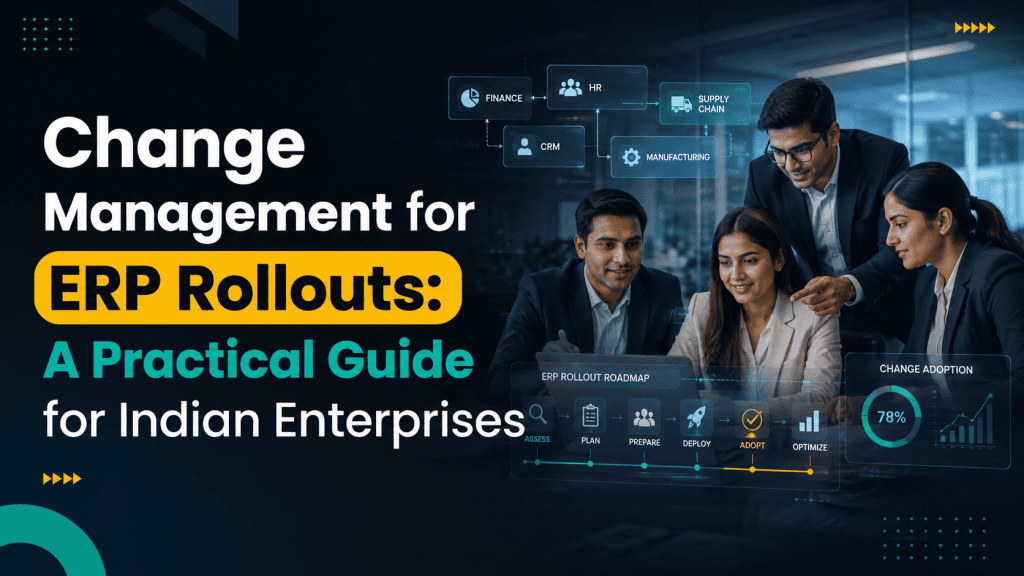
- ERP rollouts fail when organisations focus only on software implementation and ignore people readiness, communication, training, and adoption.
- A structured ERP change management process helps Indian enterprises reduce resistance, improve user adoption, and prevent teams from returning to Excel or manual workflows.
- Prosci change management, supported by Marg, helps organisations prepare leaders, managers, project teams, and users for smoother ERP adoption, stronger compliance, and long-term business value.
ERP adoption is growing in India, which makes ERP change management in India a priority for enterprises that want rollouts to deliver real value. Businesses now need stronger control over compliance, operations, data, and reporting. The India Enterprise Resource Planning market is expected to grow from USD 1.24 billion in 2026 to USD 2.62 billion by 2031 at a CAGR of 16.08% during 2026–2031. GST compliance deadlines, Digital India 2.0 subsidies, cloud migration among mid-market manufacturers, e-invoicing mandates above INR 5 crore, and RBI's real-time fraud monitoring rules are making ERP more important for Indian enterprises.
But ERP rollout is not only a software implementation. It changes how teams bill customers, manage inventory, record GST data, approve purchases, track stock movement, and generate reports. It also affects daily work across departments and requires employees to learn new processes.
Many companies invest in the right ERP platform, configure modules, migrate data, and complete basic training. Still, the rollout may fail if users do not understand why the change is happening, how their role will change, and what support they will receive.
When change is not managed properly, employees may continue using Excel, follow old approval methods, delay data entry, or create parallel records. This leads to poor data quality, low adoption, and weak business confidence in the ERP system.
This is why ERP change management is critical. It prepares people, processes, and leadership teams before, during, and after the rollout so that the ERP delivers real business value.
Typical Causes of ERP Implementation Failure
An ERP project changes the way people work. It may remove informal shortcuts, introduce mandatory data fields, create new approval flows, and make performance more visible. If these changes are not explained and supported properly, resistance is natural.
ERP implementation failure usually happens when the people side of change is ignored. The following are the most common causes.
1. Limited leadership sponsorship
Many ERP projects begin with leadership approval but not active leadership involvement. Senior management may approve the budget, but if they do not consistently communicate the importance of the rollout, users may treat it as "just another IT project." This weakens accountability and slows adoption.
2. Weak communication of the "why"
Users are often told what they need to do, such as using new forms, screens, or workflows. But they are not always told why the change matters. Without context, the ERP may feel like extra work. Effective ERP change management explains how the system will improve daily work, reduce errors, support compliance, and help the business grow.
3. No structured change management process
In many ERP rollouts, change activities are handled informally. Training happens late, communication is reactive, and support is arranged only after users start facing issues. A structured change management process brings discipline to stakeholder analysis, communication, training, adoption measurement, and post-go-live support.
4. One-size-fits-all training
Generic training sessions rarely work well for ERP users. A warehouse executive, billing operator, purchase manager, finance user, and branch head all interact with the ERP differently. ERP change management fails when training is limited to standard presentations that do not reflect local workflows, user maturity, language needs, or real operating scenarios.
5. Underestimating impact on roles and KPIs
ERP workflows often change responsibilities, approvals, reporting lines, and performance metrics. If users are not told how their role will change, they may resist the system or bypass it. This is especially important in Indian enterprises where informal processes may have been followed for years.
Organisations investing in structured change management in ERP projects can see up to 30–40% higher user adoption and faster realisation of process benefits.
Core Principles of ERP Change Management
Before creating a detailed rollout plan, organisations need to understand the principles that make ERP change management effective. These principles are especially important for Indian enterprises because of varied user profiles, regional operations, language diversity, compliance requirements, and different levels of digital maturity.
1. Start change management early
ERP change management should not begin just before go-live. By then, major decisions around scope, timelines, processes, and users may already be fixed. The better approach is to include change management from the business case and solution selection stages. This helps the organisation plan realistic timelines, internal bandwidth, training needs, and adoption risks from the beginning.
2. Focus on people readiness, not only system readiness
Technical readiness is important. Configuration, testing, data migration, integrations, and security must be done properly. But ERP success also depends on whether users are ready to follow new processes. A strong change management process prepares people for new responsibilities, new workflows, and new expectations.
3. Adapt ERP change management to Indian work styles and languages
Indian enterprises often operate across branches, warehouses, distributors, and regional offices. Not every user has the same level of comfort with technology or English-language training material. ERP communication and training should therefore be adapted to local branches, field teams, accounting staff, warehouse users, and regional language needs.
4. Measure adoption, not just project completion
Many ERP projects are declared successful once the system goes live. But real success is visible only when users consistently use the ERP for daily transactions. ERP implementation failure is often discovered after go-live, when employees return to Excel or manual records. Enterprises should therefore track adoption metrics, process compliance, support tickets, and issue trends.
A Practical Change Management Process for ERP Rollouts
A structured change management process makes ERP change management easier to execute, monitor, and improve. This is especially useful for multi-branch Indian enterprises where different teams may adopt the ERP at different speeds. The following stages provide a practical approach for ERP rollouts.
Business Case and Readiness Assessment
In this stage the organisation defines why it needs ERP, what outcomes it expects, and what business problems the system should solve. This is also the right time to assess how ready the organisation is for change.
- Identify internal change champions across operations, finance, IT, branch teams, and leadership, and estimate how much time they can realistically allocate away from BAU work.
- Assess current manual processes, local practices, approval methods, Excel trackers, and parallel systems to understand how disruptive the ERP rollout will be.
- Conduct a basic change readiness survey to identify high-risk areas, such as teams with strong resistance, low digital maturity roles, and regions with complex regulatory requirements.
Stakeholder Mapping and Impact Analysis
ERP does not affect every group in the same way. Senior leaders may use dashboards, finance teams may use reporting and compliance features, warehouse teams may use inventory modules, and billing teams may use the system for daily transactions. Each group needs a different communication and training approach.
- Classify stakeholders into groups such as top management, functional heads, supervisors, data entry staff, sales teams, warehouse teams, service teams, and accounts users.
- Define the process changes for each group, including new approval flows, mandatory fields, inventory rules, GST documentation, reporting formats, and escalation paths.
- Identify high-impact roles, such as billing operators or storekeepers in a Marg ERP deployment, because these users will experience daily operational changes.
Change Communication Strategy
Communication is the backbone of ERP change management. Users need repeated, clear, and practical communication before they are expected to change their daily work. Communication should be simple, relevant, and delivered through trusted channels.
- Use easy to understand language to explain the "why" behind the rollout — faster billing, fewer stock-outs, better GST compliance, reduced manual work, and improved reporting.
- Select credible messengers. Business owners, respected plant managers, branch heads, and functional leaders are often more trusted than external consultants or IT teams alone.
- Use multiple formats such as town halls, WhatsApp groups, posters, short videos, and FAQs in local languages for shop floor and back-office staff.
- Keep communication continuous from project kick-off to post-go-live adoption — it is not a one-time announcement.
Training Design and Delivery
Training is one of the most visible parts of change management in ERP. However, training should not be treated as a one-day demonstration. Users need practical, role-based learning that reflects how they will use the system in real business situations.
- Segment training by role, such as billing, inventory, purchase, accounts, and management dashboards, rather than giving everyone the same ERP overview.
- Blend different formats, including short in-person workshops, process walkthroughs using live or realistic data, recorded videos, and quick reference guides.
- Localise content using actual Marg ERP configurations, local tax scenarios, common stock movement patterns, and local language explanations where helpful.
- Use a "train the trainer" model carefully — internal trainers must be respected, capable, and given enough time.
Go-Live Support and Adoption Monitoring
Go-live is not the end of ERP change management — in many ways, it is the stage where change management becomes most visible. Users now have to apply what they learned in real transactions, under real business pressure, so support must be fast, accessible, and structured.
- Set up a dedicated support channel for the first 4–8 weeks, such as a helpdesk, WhatsApp group, ticketing tool, or escalation desk to capture user issues quickly.
- Monitor system adoption metrics such as daily logins, transactions per module, process compliance, and whether all sales, billing, and stock movements are being recorded in Marg ERP.
- Track support incident types, including usability issues, missing data, performance concerns, local policy conflicts, and region-wise friction points.
- Conduct short feedback surveys after the first month to identify where users are still facing difficulty in the change management process.
Continuous Improvement and Reinforcement
ERP change management does not end once the system becomes stable. After go-live, organisations need reinforcement to ensure that adoption continues and business benefits are realised, since ERP systems also evolve over time.
- Periodically review KPIs such as inventory accuracy, billing time, stock turn, compliance errors, and reporting reliability to connect ERP usage with business outcomes.
- Recognise and reward teams that fully adopt new processes — this builds positive momentum and encourages other teams to follow.
- Introduce gradual enhancements such as new reports, automation rules, GST portal integration, or external system integration through mini change cycles involving communication, training, and adoption measurement.
Conclusion: Why ERP Change Management in India Decides ERP Success
ERP change management is the link between system implementation and measurable business value. For Indian SMEs and mid-market enterprises, ERP success depends not only on software configuration, data migration, or go-live readiness, but also on how well people understand, accept, and use the new way of working.
Prosci's change management methodology focuses on preparing, equipping, and supporting people through change so that adoption becomes more consistent and sustainable.
focuses on preparing, equipping, and supporting people through change so that adoption becomes more consistent and sustainable. As authorised global affiliate and partner for Prosci in India, Marg supports organisations in integrating Prosci's role-based trainings (for sponsors, people managers, project teams, and change practitioners) into their leadership development and change programmes.With the right ERP platform and a disciplined change management process, Indian enterprises can turn ERP rollouts into long-term business transformation.
Explore Prosci's change management methodology with Marg to simplify your ERP rollout, improve user adoption, and build a stronger foundation for compliance, control, and business growth.
Frequently Asked Questions
Simplify Your ERP Rollout with Prosci Change Management
Partner with Marg to prepare your leaders, managers, and teams for a smoother, more sustainable ERP adoption.
Talk to Our Team