- Psychometric and personality assessments help Indian organizations make skill building more focused, practical, and business-aligned. These tools reveal how employees think, communicate, learn, make decisions, and respond to pressure.
- L&D teams can use these insights to design personalized development programs instead of relying on generic training formats.
- Assessments improve team collaboration by helping employees understand different working styles, strengths, and behavioral preferences.
- For leaders, these tools support deeper self-awareness, better people management, and more intentional leadership development.
Indian workplaces are going through a major shift. AI, automation, hybrid work, digital systems, and changing business models are altering not just what people do, but how people think, collaborate, communicate, and lead. In this environment, skill building cannot remain limited to standard classroom training or one-time workshops.
Organizations today need a better way to understand people before designing skill building programs, because not every employee learns, responds, decides, and communicates the same way. Some employees need structure, some learn better through discussion, while some may be confident about problem-solving but may struggle with communication.
Psychometric tools and workplace personality assessments help organizations build that level of understanding about their employees. These assessments evaluate areas such as thinking preferences, communication style, behavioral tendencies, decision-making approach, problem-solving patterns, and response to pressure.
When these patterns are identified early, skill development becomes more focused, practical, and business-aligned. In this article, let us examine seven ways psychometric and personality assessments help organizations build meaningful, measurable, and workplace-ready capabilities.
What are Psychometric and Personality Assessments?
Psychometric assessments are scientific tools used to understand cognitive abilities, reasoning patterns, aptitude, decision-making styles, and behavioral tendencies. These assessments help organizations understand how individuals think, solve problems, process information, and perform in different workplace situations.
Personality assessments focus more specifically on behavioral preferences, motivations, interpersonal styles, communication patterns, and emotional responses. A workplace personality assessment can help employees understand how personal behavior affects collaboration, leadership, conflict, and performance.
Together, psychometric assessment tools and behavioral assessment tools help organizations make skill building more targeted. Instead of assuming that every employee learns or performs in the same way, these tools help HR, L&D teams, managers, and coaches design development interventions around real human differences.
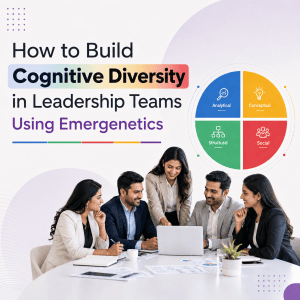
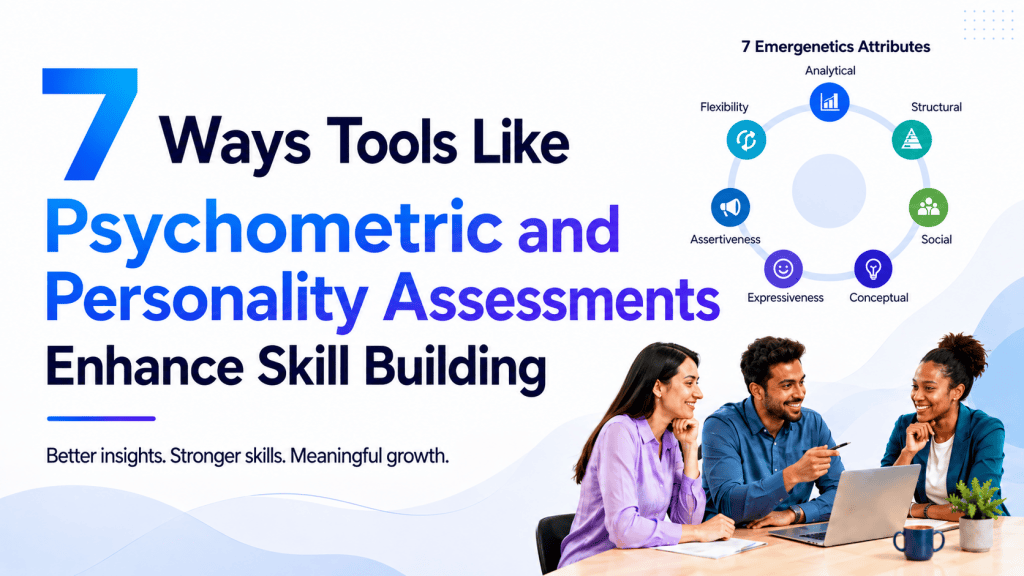
A strong example is Emergenetics, a neuroscience-based assessment that identifies seven thinking and behavioral attributes. It goes beyond profiling by offering practical ways to apply these insights, helping individuals build self-awareness, improve collaboration, and drive better performance through cognitive diversity.
How Psychometric and Personality Assessments Enhance Skill Building
1. Create Deep Self-Awareness and Unlock Intentional Growth
Skill building begins with self-awareness. Too often, people assume they "know" their strengths without understanding how they actually process information, communicate, or respond to pressure.
Psychometric assessments break that assumption by revealing preferences that are not always obvious from surface behavior. By identifying thinking preferences, communication tendencies, and behavioral styles, they give learners a clearer picture of how they approach tasks, solve problems, and interact with others.
That awareness helps people choose development paths that match their natural strengths while also targeting areas that need more support. This is especially useful for soft-skill growth.
If someone understands that they prefer structure and detail, for example, they can intentionally stretch into creative problem-solving or ambiguity tolerance rather than treating those areas as fixed limitations.
2. Personalize Learning Design and Delivery
One of the biggest reasons traditional training fails is that it assumes everyone learns the same way. But every person absorbs information differently. Some prefer structured models and step-by-step practice; others prefer stories and group discussions, and still others need big-picture frameworks before diving into details.
Psychometric and personality assessments help L&D teams and managers personalize learning by aligning content, pace, and delivery methods with learners' preferences. Psychometric assessment tools like Emergenetics support this kind of customization with its attribute model that directly suggests how different types of learners respond best to different teaching styles.
For instance:
- Analytical thinkers may get most value from problem-based learning, case studies, and data-driven exercises.
- Structural thinkers may benefit from clear agendas, checklists, templates, and hands-on practice.
- Social thinkers may thrive in collaborative workshops, role-plays, and peer discussions.
- Conceptual thinkers may prefer future-oriented scenarios, innovation labs, and exploratory debates.
This matters for Indian organizations because training budgets must show stronger business value. A generic workshop may create short-term awareness, but a personalized learning journey is more likely to improve retention, application, and workplace behavior.
3. Strengthen Communication and Interpersonal Skills
Communication is one of the most important workplace skills, but it is also one of the hardest to improve through theory alone. Behavioral assessment tools help people see how their style affects tone, pace, listening, feedback, and conflict.
When individuals understand their communication tendencies, they can adjust more effectively for different audiences. For example, someone who prefers direct communication can learn to slow down for stakeholders who need more context, while someone who is more reflective can practice speaking up earlier in team discussions.
This kind of development goes beyond generic "communication training." It helps people understand the behavioral patterns behind misunderstandings, which makes change more durable and practical.
4. Foster Cognitive and Behavioral Diversity in Teams
Modern organizations increasingly rely on cross-functional, project-based teams, where success depends on how well people with different thinking styles and personalities collaborate. Psychometric tools help teams appreciate diversity not as a challenge, but as a performance advantage.
These tools enable team mapping exercises that visualize where each member falls across key thinking and behavioral dimensions, creating a shared model of "how this team thinks."
This approach helps teams:
- Understand why certain members naturally focus on details, others on people, and others on possibilities.
- Identify gaps in the team's thinking — for example, a group heavy on analytical and structural approaches but light on social and conceptual perspectives.
- Assign roles, tasks, and decision-making responsibilities in ways that leverage diversity instead of creating friction.
When teams see their varied styles as complementary, they become more psychologically safe. Members are less likely to label differences as "wrong" and more likely to treat them as opportunities to learn from each other.
5. Accelerate Leadership and Management Development
As companies expand, digitize, and restructure, managers need more than technical expertise. They need leaders who can coach, influence, communicate, manage resistance, build trust, and guide people through uncertainty.
But developing leadership is one of the most complex, high-stakes skill-building journeys an organization can undertake. It requires not just technical competence, but emotional intelligence, adaptability, and the ability to motivate people with different working styles.
Psychometric assessments help reveal how a leader's natural thinking and behavioral preferences shape their management style. For example:
- A leader with high Analytical thinking may naturally focus on metrics, risk, and data-driven decisions, but might need to consciously develop Social or Conceptual skills to inspire teams and think long-term.
- A Social leader may excel at relationship building and empathy but may need to strengthen Structural or Analytical skills to drive accountability and clear processes.
Many assessment-based leadership development programs then help leaders identify default patterns, map them against team needs, and set personalized goals. This strength-based approach frames development as growth, not remediation.
6. Make Reskilling and Upskilling More Efficient and Sustainable
India is entering a major reskilling phase. AI adoption, automation, cloud systems, data tools, and digital workflows are changing job expectations across industries.
India's young workforce shows higher confidence in using AI at work compared with the global average — with 85% of Gen Zs and 91% of millennials confident in applying AI in their roles.
This creates an important opportunity. Indian professionals are ready to upgrade, so organizations must design reskilling journeys that feel relevant and usable.
Psychometric tools help organizations segment learning needs more intelligently. For example, during digital transformation, some employees may need confidence-building before tool training. Some may need structured workflows. Some may need hands-on practice. Some may need manager coaching. Some may need peer learning. Some may need clarity on how the new skill connects to career growth.
When learning design reflects these differences, adoption improves.
7. Embed Learning into Ongoing Behavior Change, Not One-Off Events
One of the most common pitfalls in skill building is that new learning doesn't stick. People attend a workshop, read a few action items, and then return to their usual patterns.
Employees need reflection, practice, coaching, manager support, and reinforcement. A workplace personality assessment can support this longer journey.
For example, after an Emergenetics® profile, an employee can use the insights during feedback discussions, project planning, stakeholder communication, conflict resolution, and career development. A manager can use the same insights before a difficult conversation. A team can revisit the profile before starting a major project. This keeps learning alive.
Ready to Build Skills That Stick and Scale?
If you want to transform psychometric insights into real-world growth — from onboarding new hires to reskilling teams and developing leaders — let's talk. Explore Emergenetics® Certification with Marg to equip your HR, L&D, and leadership teams with practical skills for personalized, high-impact skill building across the organization.
Explore Emergenetics® Certification