In 2025, disruption is now a business reality, not a distant risk. From unpredictable market shifts to rapid technological advances, the pace of change is accelerating, and business leaders are expected to deliver continued results, no matter the headwinds. One non-negotiable capability that has become a C-suite priority is organisational resilience – a strategic capability that determines whether companies adapt, thrive, or get left behind.
According to recent research from McKinsey, Deloitte, and BCG, organisational resilience is shifting from narrow risk management functions to a multidimensional, enterprise-wide capability that underpins growth, ensures continuity, and accelerates change management and digital transformation initiatives.
This article explores why building organisational resilience matters in the era of transformation, offers frameworks that turn theory into practice, examines real-world examples, and provides actionable pathways for leaders steering through uncertainty.
Defining Organisational Resilience: The Strategic Imperative
Organisational resilience is the ability of an enterprise to adapt and prosper through change, uncertainty, and disruption. It’s what keeps teams focused and organisations progressing even when transformation feels overwhelming.
Why Is Organisational Resilience Strategic?
- Sustained Performance Amid Disruption: Resilient organisations recover faster and outperform peers during shocks.
- Enabler for Change Management: It reduces “change fatigue,” empowers people, and accelerates adoption.
- Foundation for Digital Transformation: Success depends as much on adaptive people and processes as on technology.
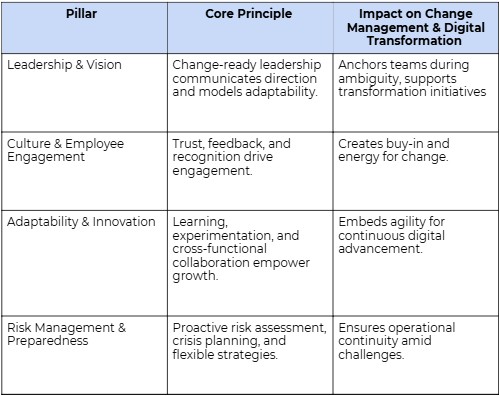
The Organisational Resilience Framework: Pillars for Lasting Adaptability
Building organisational resilience requires a systematic approach. Here are the four foundational pillars of a resilient organisation that should be top-of-mind for leaders:
Actionable Steps for Building Organisational Resilience
Leaders seeking a roadmap can adapt these building blocks, drawn from the latest Prosci research and proven across industries:
- Assess Current Capabilities
- Evaluate strengths and gaps in leadership, communication, and employee readiness.
- Audit maturity of current change management practices.
- Develop Crisis Management Plans
- Predefine decision-makers and escalation procedures.
- Establish transparent, frequent communication channels.
- Test and adapt response plans regularly.
- Invest in Technology and Infrastructure
- Choose systems that enable remote/hybrid work, cross-functional collaboration, and real-time data for decision-making.
- Prioritise digital tools that simplify rather than complicate change.
- Train and Empower Employees
- Build continuous learning programs.
- Encourage problem-solving and bottom-up innovation.
- Empower teams to own change initiatives.
- Integrate Change Management Frameworks
- Apply Prosci’s ADKAR Model for individuals and 3-Phase Process for organisational change.
- Incorporate structured approaches: mental health resources, coaching, and clear frameworks make transitions smoother.
Real-World Impact: Business Case Studies
These organisations exemplify resilient transformation:
Washington State Department of Health
Challenge: Post-pandemic burnout, high turnover, and fatigue threatened service delivery.
Response:
- Built strong executive sponsorship for change.
- Embedded structured change management.
- Developed “change-ready” teams.
- Regained momentum despite ongoing adversity.
Oregon Lottery
Approach:
- Formalised change management training using the Prosci methodology.
- Empowered staff with skills and frameworks for agility.
Results:
- Achieved 95% employee engagement in major initiatives.
- Reduced barriers to new technology adoption.
Organisational Resilience & Change Management: A Unified Framework
Organisational resilience doesn’t happen in a vacuum. It is deeply intertwined with change management. In fact, building change capability is a core part of building long-lasting resilience.
Prosci’s Enterprise Change Management (ECM) framework is especially relevant here –: building organisational change capability should itself be treated as a change with structure, intent, and metrics.
Some best practices include:
- Treat capability building like a project: define current versus future state, chart a roadmap, and apply change methodologies.
- Embed change management into your organisational DNA: use common frameworks, tools, and language so that change becomes “how we operate” rather than a one-off event.
- Use multi-faceted approaches: leadership engagement, training, sponsorship, and structured processes combined make your change capability robust.
How Resilience Drives Digital Transformation Success
Digital transformation places unprecedented demands on organisations, and resilience is what determines whether they thrive or struggle. When leadership, culture, and change capability are strong, people can adopt new tools, adjust ways of working, and deliver results even through uncertainty. Resilient organisations meet technological disruption with confidence and maintain momentum throughout the transition.
How Resilience Enables Digital Transformation
- Adaptable Workforce: Resilient teams embrace new technologies more easily and stay productive through digital change.
- Continuity During Transition: Strong communication, planning, and flexibility minimise disruption as legacy systems shift to new platforms.
- Decision Agility: Resilience builds the clarity and trust needed for teams to make timely, confident decisions during implementation.
- Sustained Momentum: Resilient organisations adjust to setbacks, maintain engagement, and realise digital value faster.
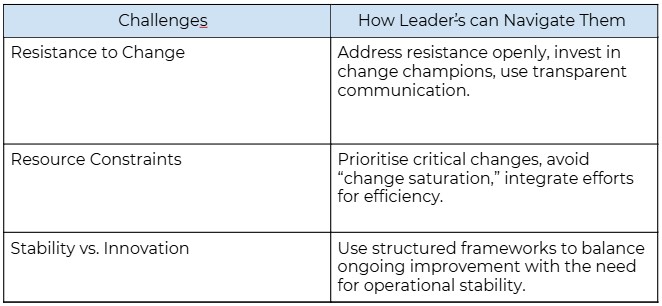
Common Challenges in Building Organisational Resilience (and How to Overcome Them)
Achieving resilience means facing and proactively managing key roadblocks:
The Payoffs of Organisational Resilience
Developing sustained organisational resilience creates advantages that ripple across every layer of a business:
- Faster Recovery: Bounce back from supply chain shocks, workforce disruption, and market volatility.
- Engaged Workforce: Higher engagement, lower turnover, and increased employee loyalty.
- Competitive Edge: Anticipate risks, seize opportunities faster than competitors.
- Long-Term Value: Integrates risk management, change agility, and customer-centricity.More to Read –11 Elements of Successful Organizational Change Management
Key Takeaways for Business Leaders and Change Professionals
- Resilience is not accidental.
Building organisational resilience demands deliberate strategy, investment, and culture-building. - Embed resilience everywhere.
Make it part of every strategy session, risk review, and leadership conversation. - Prioritise people.
Empower, upskill, and engage employees; they are the true engines of resilience. - Leverage Change Management.
Use structured change frameworks like ADKAR to build resilience intentionally – as a capability, not a side project. - Lead with vision.
Transparent, adaptable leadership inspires trust and builds readiness, whatever the next change brings.
Final Thoughts
In an era defined by uncertainty, disruption, and relentless transformation, organisational resilience is no longer optional; it is a strategic differentiator. By intentionally building resilience through strong leadership, a culture of adaptability, risk preparedness, and continuous learning, organisations can convert change into competitive advantage.
Resilience enables companies to respond not just reactively but proactively to convert uncertainty into growth, turn challenges into opportunities, and embed change-readiness into their very identity. With a structured change management framework like Prosci’s, organisations can make resilience part of their DNA.
The future belongs to change-ready, resilient organisations. At Marg Business Transformation, as Prosci’s authorised affiliate in India since 2017, we remain committed to helping organisations and professionals build the change capability needed for a rapidly evolving world. Through structured methodologies, practical tools, and a deep focus on people, we support leaders in strengthening the resilience that modern transformation demands. As the pace of change accelerates, we look forward to helping organisations move forward with confidence, clarity, and readiness.